
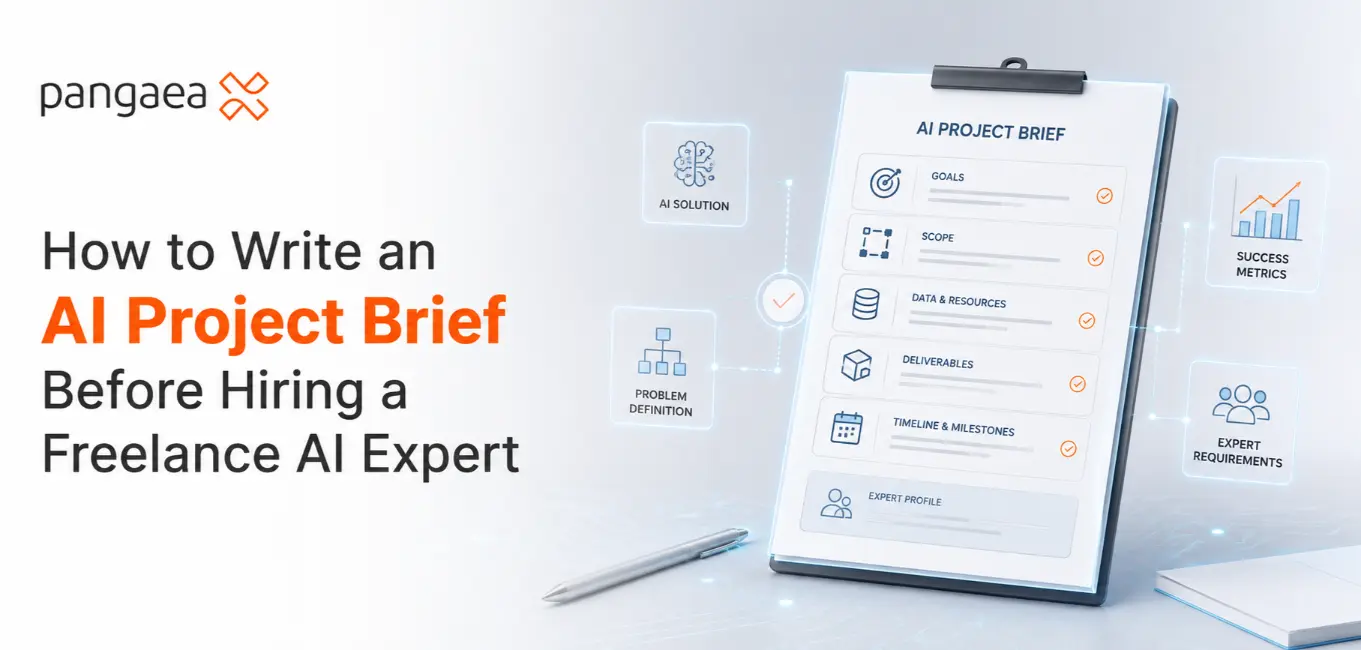
Introduction
A freelance AI expert can recommend models, tools and implementation methods, but they cannot define your business objective for you. If a project begins with a request such as "build us an AI solution," every proposal will be based on a different interpretation of the problem.
A useful AI project brief removes that ambiguity. It explains the business problem, available data, intended users, expected output, constraints and definition of success. It does not need to contain a finished technical design. Its purpose is to give a specialist enough context to assess feasibility, recommend an approach and provide a realistic proposal.
The following framework can be used before posting a project or speaking with a freelance AI expert.
First Decide Whether AI Is the Right Approach
The first question is not which model to use. It is whether the problem needs AI at all.
Start by writing the desired outcome without using terms such as AI, machine learning or automation. For example:
- Weak: "We need an AI customer-retention tool."
- Stronger: "We want account managers to identify customers at risk of cancellation early enough to take action."
The stronger version defines the business need without assuming the solution. A rule-based workflow, better reporting or a conventional statistical model may solve the problem more effectively than a complex AI system.
Google's current machine-learning problem-framing guidance recommends defining a clear non-ML goal, checking whether AI is suitable and confirming that the necessary data exists before implementation begins.
Add these questions to the opening of your brief:
- What decision or process needs to improve?
- Who experiences the current problem?
- What happens if the problem is not solved?
- Why is AI being considered?
- What simpler approach has already been tried?
Define the Business Problem in Plain Language
Describe the current situation, the friction it creates and the desired change. Avoid starting with a tool or model.
For example:
Our support team receives approximately 2,000 requests per week. Agents manually classify each request before assigning it to a department. We want to reduce manual classification while ensuring urgent requests reach the correct team.
This gives a freelancer more useful context than "build an NLP ticket-classification model." The expert can now ask about categories, languages, urgency rules, available tickets and how misclassification affects the business.
Your problem statement should cover:
- The current process
- The specific bottleneck
- The people affected
- The desired business outcome
- Known risks or consequences
Describe the Data You Have
AI project feasibility often depends more on the data than the proposed algorithm. A freelancer needs to know what information is available before recommending a solution.
Include:
- Data sources and file formats
- Approximate volume and history
- Whether labels or outcomes already exist
- Known missing values or quality problems
- Languages, regions or customer groups represented
- Access restrictions and approval requirements
- Personal, financial, health or confidential information
- Whether data can leave the current environment
Do not upload sensitive data with the first public project post. Describe it at a high level and define how access will be handled after the appropriate agreement and controls are in place.
If the data is incomplete, say so. An experienced freelancer may propose a data-readiness phase before model development. Hiding the problem usually produces an inaccurate quote and delays the project later.
Define the Required Output and Its Users
The same underlying model can be delivered in several ways. A business may need a one-time analysis, an API, a dashboard, an internal workflow, an application feature or a proof of concept.
Explain:
- Who will use the output
- Where it must appear
- What action the user will take
- How frequently it must run
- Whether a human must approve the result
- What explanation or confidence information users require
For example, "predict customer churn" is incomplete. A clearer output requirement would be:
Provide a weekly list of at-risk accounts inside the existing CRM, with the main contributing factors and a recommended priority level for account managers.
This connects the model with an actual workflow.
Separate Business Success From Model Performance
An AI system can perform well on a technical metric without improving the business.
Your brief should define two types of success criteria.
Business success criteria
These measure whether the project produces the intended operational result. Examples include:
- Fewer requests requiring manual classification
- Faster response time
- More completed quality checks
- Lower avoidable rework
- Higher use of a recommendation by the intended team
Model or system criteria
These measure technical quality. Depending on the use case, they may include precision, recall, error rate, latency, answer quality, cost per request or failure rate.
Google's guidance on measuring machine-learning project success makes the same distinction: strong model metrics do not guarantee a better business outcome.
For generative AI projects, also define how outputs will be reviewed. Open-ended responses may require a test set, human evaluation rubric, error categories and unacceptable-output criteria.
Set Scope Boundaries and Constraints
An effective brief states what the project does not include.
Specify:
- Required and prohibited technologies
- Existing cloud or on-premise environment
- Systems that require integration
- Security and privacy requirements
- User languages and regions
- Expected number of users or requests
- Performance and response-time expectations
- Whether the project is a prototype or production deployment
- Responsibilities that remain with the internal team
A prototype built from a sample file is very different from a production service that must process live customer information. Make that distinction before requesting a price.
List the Deliverables
Do not use "working AI solution" as the only deliverable. List the items you expect to receive.
A project may include:
- Data-quality assessment
- Feasibility findings
- Prototype or baseline model
- Training and evaluation code
- Prompt or model configuration
- API or application integration
- Evaluation report
- Error analysis
- User documentation
- Technical documentation
- Deployment instructions
- Monitoring recommendations
- Knowledge-transfer session
Also state who will own the code, documentation, configuration and other project assets after payment. If third-party models, datasets or libraries will be used, require the freelancer to document their licences and ongoing costs.
Break the Work Into Milestones
Milestones allow both sides to review assumptions before too much work is committed.
A practical sequence could be:
- Discovery and data review: Confirm the problem, data and feasibility.
- Baseline: Create a simple benchmark against which later work can be measured.
- Prototype: Build and test the selected approach on a controlled dataset.
- Evaluation: Review technical performance, business usefulness and failure cases.
- Integration: Connect the approved system with the required workflow.
- Handover: Deliver code, documentation, access details and training.
Each milestone should have an output, review process and acceptance condition. Avoid approving a milestone only because a demonstration looks impressive.
Include the Information Needed for an Accurate Proposal
Before quoting, a freelancer will usually need to understand:
- The problem and expected outcome
- Data readiness
- Required deliverables
- Technical environment
- Timeline and dependencies
- Budget range or commercial constraints
- People available for feedback
- Approval and procurement process
If an important detail is unknown, label it as an open question rather than guessing.
Copy-Ready AI Project Brief Template
Use the following structure for your first draft.
Project name
A short internal name for the project.
Business problem
What is happening now, who is affected and why it matters?
Desired outcome
What should become easier, faster, safer or more accurate?
Intended users
Who will use the system or its output?
Available data
What data exists, where is it stored and what restrictions apply?
Required output
What should the expert deliver, and where will it be used?
Success criteria
List business measures, technical measures and unacceptable outcomes.
Scope
What is included and excluded?
Technical environment
List required integrations, infrastructure and technology constraints.
Deliverables
List code, models, reports, documentation, deployment and handover requirements.
Timeline and milestones
State the desired schedule, dependencies and review points.
Budget and engagement model
Indicate whether you expect a fixed-price project, hourly engagement or milestone-based proposal.
Open questions
List decisions that require expert input.
Turning the Brief Into an OutsourceX Project
Once the brief is ready, you can use it to post an AI project on OutsourceX and compare proposals against the same requirements.
The brief also helps you evaluate whether a candidate has relevant experience. When reviewing freelance AI experts, look for evidence connected to your data type, use case, deployment environment and evaluation needs rather than selecting solely by a list of tools.
Frequently Asked Questions
Does an AI project brief need a technical solution?
No. It should explain the problem, data, outcome and constraints. A qualified specialist can then recommend the technical approach and explain the trade-offs.
Should a budget be included?
A realistic range can help freelancers propose an approach that fits the available resources. If the budget is not fixed, state the preferred engagement model and ask for phased options.
How detailed should the data description be?
Provide enough information to assess feasibility without publicly exposing sensitive or confidential information. Detailed data access can be arranged later under appropriate controls.
Conclusion
A good AI project brief does not attempt to answer every technical question. It gives the expert a reliable starting point.
Define the business problem first, describe the data honestly, explain the required output and separate business success from model performance. Then document scope, constraints, deliverables and milestones.
This preparation improves the quality of proposals and helps both the business and freelancer identify risks before development begins.