
Python Competitions to Test, Improve and Prove Your Skills
Learning Python is one thing. Applying it to an unfamiliar problem is another. Python competitions give you a structured way to use your coding, data and problem-solving skills in practical scenarios, helping you understand what you can already do well and where you need more practice.
Understanding Python Competitions and Their Practical Value
A Python competition is a structured challenge where participants use Python to solve coding, debugging, data, analytical or problem-solving tasks. Depending on the format, participants may be evaluated on correctness, accuracy, logic, efficiency, completion or other defined criteria.
Unlike a tutorial, where the method is usually explained step by step, a competition gives you a problem and asks you to decide how to approach it. This makes Python competitions useful for moving from knowing concepts to applying them independently.
From Learning Python to Applying It
You may already understand loops, functions, lists, dictionaries, pandas or NumPy. A competition helps you discover whether you can combine those skills when the answer is not already shown to you.
- Apply Python concepts to practical problems
- Solve tasks without step-by-step instructions
- Test coding and analytical thinking
- Discover areas that need more practice
- Build confidence when solving unfamiliar problems
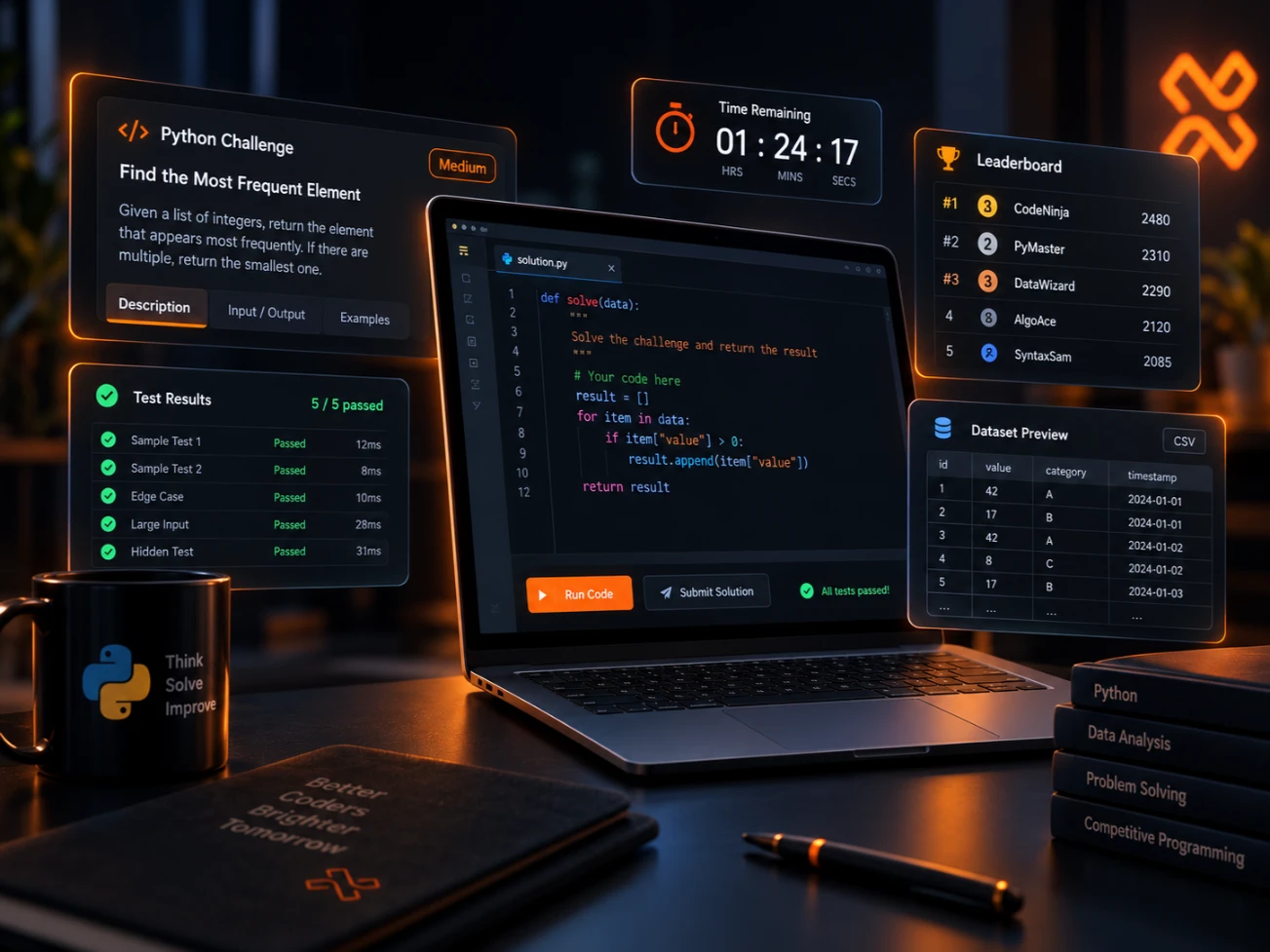
Python Competitions vs Regular Python Practice
Practice problems and competitions both help you improve, but they serve different purposes. Practice is useful for learning or reinforcing a concept. Competitions are useful for testing whether you can apply one or more concepts independently in a structured problem.
| Aspect | Python Practice Problems | Python Competitions |
|---|---|---|
| Main purpose | Learn or reinforce concepts | Apply and test skills |
| Structure | Individual exercise | Structured challenge |
| Problem type | Usually concept-specific | Can combine multiple skills |
| Benchmarking | Limited | May include scoring or ranking |
| Recognition | Usually none | May include certificates or rewards |
| Best use | Learning and repetition | Testing practical application |
The strongest learning path is often to use practice problems to learn individual concepts, then use competitions to see whether you can apply those concepts without being guided through every step.
Python Competition?
Python competitions provide a structured environment where participants can apply their programming knowledge, solve practical problems, and evaluate their skills through different types of challenges.
Why Participate in Python Competitions?
Python competitions provide opportunities to apply programming knowledge, develop problem-solving abilities, evaluate practical skills and understand areas for improvement through structured challenges.
- Turn Knowledge Into Practical SkillsCompetitions require you to decide which Python concepts are relevant and how to use them. This develops stronger problem-solving and independent thinking than simply following an example.
- Discover Your Skill GapsA challenge can reveal whether you need more practice with debugging, data manipulation, functions, algorithms, pandas, NumPy or analytical reasoning. This gives you a clearer idea of what to improve next.
- Benchmark Your AbilityDepending on the challenge format, scores, rankings or evaluation criteria can help you understand how effectively you solved the problem and how your performance compares with a defined benchmark or other participants.
- Build Evidence of Applied SkillsCompleting practical challenges gives you evidence that you have actively used Python to solve problems, rather than simply listing Python as a skill.
What Can You Expect in a Python Competition?
Python competitions can take different forms depending on the skills being tested. Some focus on coding fundamentals, while others use datasets, debugging exercises, analytical scenarios or more complex logic.
- Coding Challenges
Solve programming and logic-based problems using Python.
- Debugging Challenges
Find errors, interpret existing code and correct faulty logic.
- Data Cleaning Challenges
Handle missing values, duplicates, inconsistent data and common preparation tasks.
- Timed Challenges
Solve one or more problems within a defined time period.
- Data Analysis Challenges
Work with datasets using Python, pandas and NumPy.
- Algorithm Challenges
Develop logical and efficient solutions to structured computational problems.
- Real-World Problems
Apply Python to practical business, analytics or data scenarios.
- Knowledge Challenges
Test understanding of syntax, code output, functions and Python behaviour.
What Skills Can Python Competitions Test?
Python competitions test a combination of programming knowledge, problem-solving ability, data handling skills and analytical thinking through different types of challenges.
- Python Fundamentals
Variables, data types, conditions, loops, functions, lists, dictionaries, sets and tuples.
- Problem Solving
Logical thinking, debugging, code interpretation and breaking complex problems into smaller steps.
- Algorithms
Searching, sorting, data structures and efficiency.
- Data Cleaning
Missing values, duplicate records, inconsistent values, data validation and type conversion.
- Analytical Thinking
Exploring data, aggregating information, identifying patterns and extracting useful insights.
- Data Handling
Pandas, NumPy, filtering, sorting, grouping and transformation.
Who Can Participate in Python Competitions?
Python competitions are not only for expert programmers. Different difficulty levels can make them useful for people at several stages of learning and professional development.
- Beginners Learning Python
If you understand the fundamentals, beginner challenges can help you move from basic exercises to practical application.
- Students
Students can use competitions to turn classroom, course or self-learning knowledge into hands-on problem-solving experience.
- Machine Learning Professionals
ML professionals can strengthen the Python foundations used across data preparation, modelling workflows and technical problem solving.
- Aspiring Data Analysts
Data-focused Python challenges can provide hands-on practice with pandas, data cleaning, transformations and analytical thinking.
- Data Scientists
Python competitions can test programming, data handling, analytical reasoning and the ability to solve unfamiliar technical problems.
- Working Data Professionals and Career Switchers
Experienced professionals can keep skills active, while career switchers can use structured challenges to bridge the gap between learning a skill and applying it.
Are Python Competitions Suitable for Beginners?
Yes. You do not need advanced Python knowledge to start. The important part is choosing a challenge that matches your current skill level and progressing gradually.
- Beginner Level
Typical areas may include variables, loops, functions, lists, dictionaries, conditions and basic pandas. This level is suitable for people who know the basics but need hands-on practice.
- Intermediate Level
Typical areas may include pandas, NumPy, data cleaning, functions, debugging, aggregations and introductory algorithmic thinking.
- Advanced Level
Advanced challenges may involve complex logic, algorithms, optimization, multi-step data manipulation and analytical problem solving.
Advantages of Participating in Python Competitions
Python competitions are not only for expert programmers. Different difficulty levels can make them useful for people at several stages of learning and professional development.
- Hands-on Experience
Apply Python instead of only learning syntax and concepts.
- Problem-Solving Practice
Learn how to approach unfamiliar tasks and make decisions independently.
- Real-World Exposure
Work with practical scenarios and datasets beyond textbook exercises.
- Skill-Gap Discovery
Identify specific topics that require more practice.
- Skill Benchmarking
Understand your practical level through defined evaluation where available.
- Confidence Building
Become more comfortable solving problems without step-by-step guidance.
- Continuous Improvement
Progress from simpler problems to more difficult challenges over time.
What Kind of Python Problems Might You Solve?
Python problems can cover different scenarios including data preparation, debugging, analysis and algorithmic thinking. These challenges help test practical application of Python skills.
- Data Cleaning Problem
A dataset contains duplicate customer records, missing transaction values and inconsistent data types. Your task is to identify the issues and produce a clean dataset that can be used for analysis.
Skills involved: Python, pandas, missing values, duplicates, data validation.
- Debugging Problem
A Python function is returning the wrong monthly revenue figure. Review the code, identify the logical error and determine the correct output.
Skills involved: Functions, debugging, code interpretation, logic.
- Data Analysis Problem
Analyze transaction data and determine which product category produces the highest average order value.
Skills involved: Pandas, GroupBy, aggregation, analytical reasoning.
- Algorithmic Problem
Given a large list of records, identify an efficient approach for detecting repeated values while keeping the solution clear and practical.
Skills involved: Python, data structures, algorithms, efficiency.
Common Misconceptions About Python Competitions
Python competitions often come with assumptions about difficulty, competition level and expected outcomes. Understanding these misconceptions can help you approach challenges with the right expectations.
- “I Need to Be an Expert.”
Not necessarily. Beginner and intermediate challenges can be a useful next step once you understand the basic concepts.
- “Python Competitions Are Only About Algorithms.”
Python challenges can also involve debugging, data analysis, data manipulation, cleaning and practical scenarios.
- “I Have to Compete Professionally.”
You can participate simply to practice, test yourself, benchmark your skills and identify what to improve.
- “If I Do Not Win, Participating Has No Value.”
The learning, problem-solving experience and skill-gap discovery can be valuable regardless of your final position.
Think You Know Python?
Put It Into Practice
The best way to understand your practical ability is to solve a problem without being shown every step. Explore Python challenges on CompeteX and find one suited to your current level.
Why Compete on CompeteX

Test Real-World Data
Skills

Build Proof of Your
Skills

Earn Certificates

Win Cash Rewards

Climb the Leaderboard
Ready to Put Your Skills to the Test?
Learning builds knowledge. Challenges help you apply it. Explore CompeteX and discover practical competitions designed to test data, analytics and technical skills.
Authenticate Your Skills with AuthenX
CompeteX helps you apply your Python skills through practical challenges, while AuthenX helps you authenticate those capabilities through AI-driven interviews and portfolio screening. With conversation-based assessments, you can gain real insights into your skills and receive an AI Performance Report, Authenticated Badge & Certificate, and Smart Ranking.
Recognized By








Related Articles

Statistics Cheat Sheet for Data Analyst Interviews: Tests, Distributions, Probability & A/B Testing
Introduction Statistics questions in data analyst interviews are rarely limited to definitions....
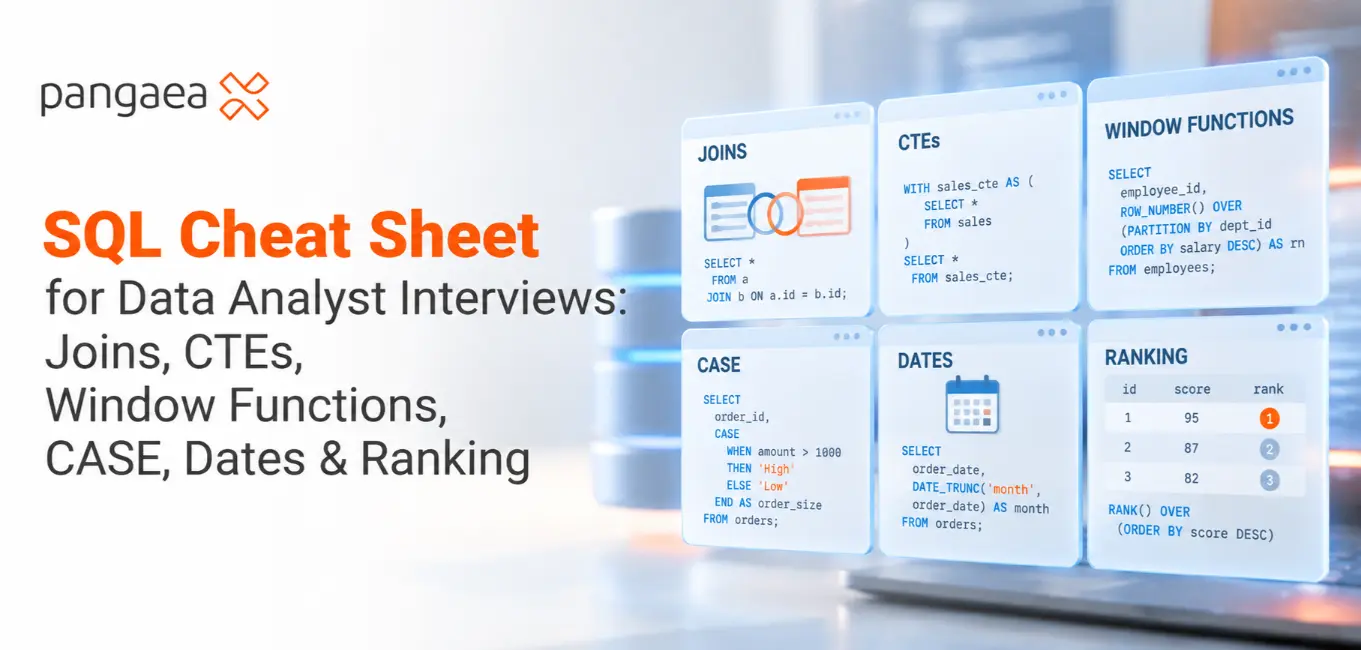
SQL Cheat Sheet for Data Analysts: Joins, CTEs, Window Functions, CASE, Dates and Ranking
Introduction Data analysts rarely use SQL to answer isolated technical questions. Most tasks begin...
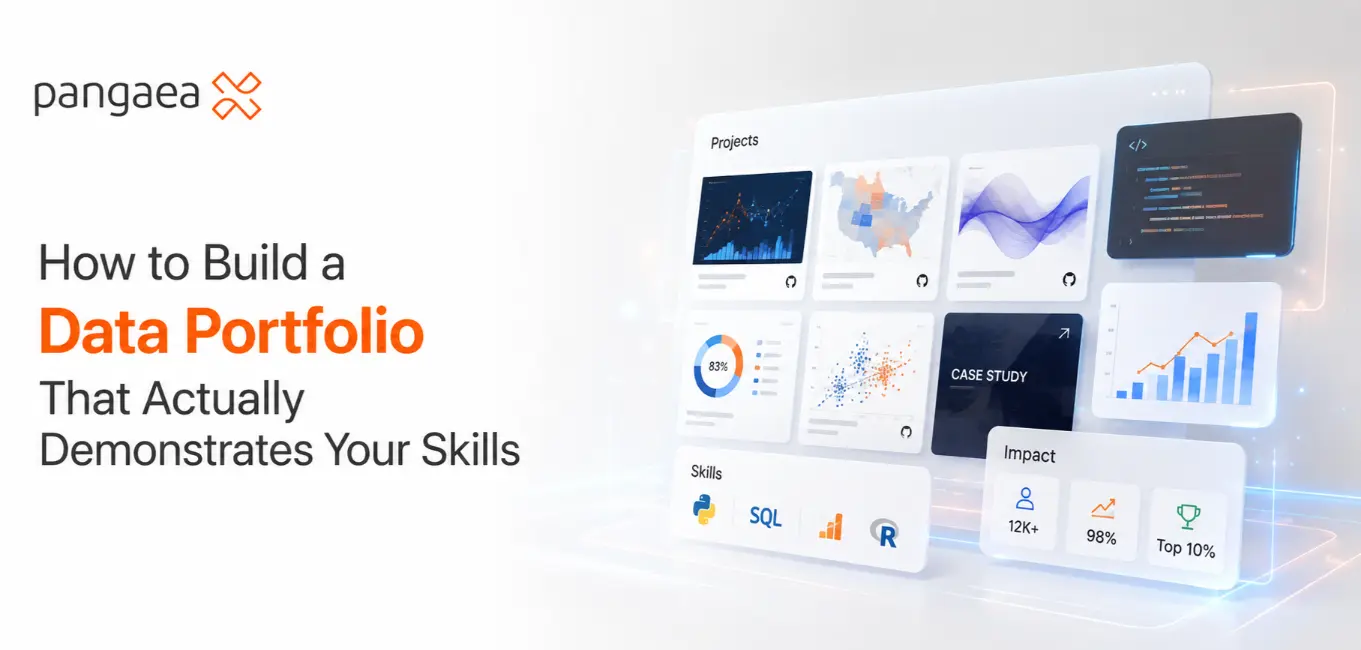
How to Build a Data Portfolio That Actually Demonstrates Your Skills
Introduction Completing data projects is useful, but a collection of notebooks,...
Frequently Asked Questions
What is a Python competition?
A Python competition is a structured challenge where participants use Python to solve coding, debugging, analytical, data or problem-solving tasks according to defined requirements.
Can beginners participate in Python competitions?
Yes. Beginners can start with challenges focused on Python fundamentals such as variables, loops, lists, dictionaries, functions and basic data manipulation before moving to more advanced problems.
What skills are tested in Python competitions?
Depending on the challenge, participants may be tested on Python fundamentals, pandas, NumPy, data cleaning, debugging, algorithms, data manipulation and analytical problem solving.
Are Python competitions useful for data analysts?
Yes. Data-focused Python challenges can help analysts practice common tasks such as cleaning datasets, transforming data, aggregating information and solving analytical problems.
What is the difference between a Python challenge and a Python competition?
Your content goes here. Edit or remove this text inline or in the module Content settings. You can also style every aspect of this content in the module Design settings and even apply custom CSS to this text in the module Advanced settings.
Do I need advanced Python knowledge to participate?
No. The appropriate level depends on the competition. Participants who know the basics can begin with beginner-level challenges and progress toward more complex problems.
How can I prepare for a Python competition?
Review Python fundamentals, solve practice problems independently, practice debugging and work with real datasets. For data-oriented challenges, familiarity with pandas and NumPy can also be helpful.
Can Python competitions help improve my coding skills?
Yes. They can help you practice applying Python to unfamiliar problems, strengthen logical thinking, discover skill gaps and become more confident working independently.
Where can I participate in Python competitions online?
CompeteX provides structured data and technical challenges where participants can apply Python and other data skills to practical problems.
Explore Other Challenge Categories
Explore More Across PangaeaX
PangaeaX brings together competitions, skill verification, community and freelance opportunities in one data-focused ecosystem. Build practical experience with CompeteX, validate your capabilities with AuthenX, connect with other data professionals through ConnectX, and explore freelance opportunities through OutsourceX.