
Introduction
For decades, the dashboard was the endpoint of data work. You built the pipeline, cleaned the data, ran the analysis, and delivered a chart someone else would look at and act on. That model worked when markets moved slowly and data volumes were manageable. It doesn't anymore.
A new approach is gaining serious ground in enterprise data: agentic analytics. It doesn't just change how data is visualised. It changes who, or what, acts on it. And for data professionals, understanding this shift is no longer optional.
The Problem With Dashboards
Dashboards are fundamentally reactive. They describe what happened. They answer the questions someone thought to ask. But they require a human at every step: to notice an anomaly, to investigate it, to connect it to other data, to form a hypothesis, and to decide what to do.
In a world of real-time signals, exponential data growth, and compressed decision windows, that human-mediated cycle is increasingly the bottleneck. Enterprises today are drowning in dashboards but starving for decisions. The issue isn't visibility. It's the gap between seeing something and doing something about it.
What Agentic Analytics Actually Is
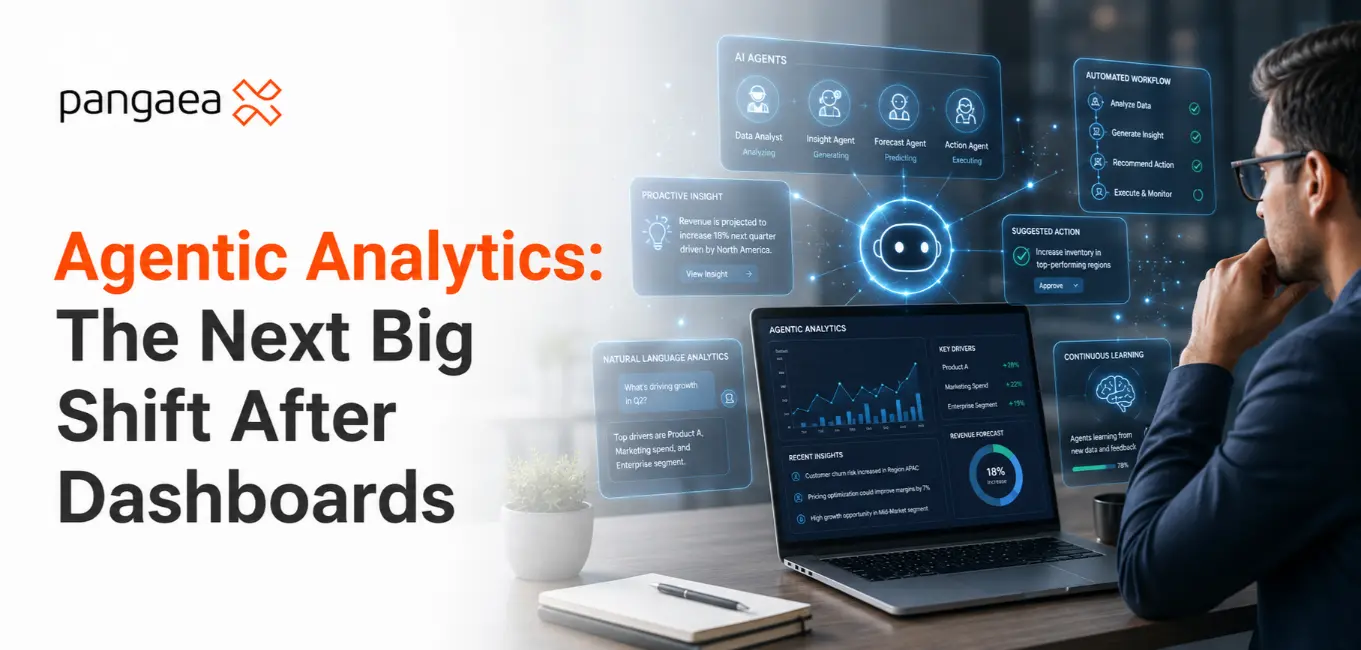
Agentic analytics is the use of autonomous AI agents to monitor data, generate insights, and recommend or execute actions, without waiting for a human to ask the right question.
The term combines two ideas: agentic (the ability to act independently toward a goal) and analytics (the systematic study of data). Together, they describe systems that don't just surface patterns but respond to them.
This builds on earlier generations of analytics maturity:
- Manual SQL: users queried databases directly
- BI Dashboards: data visualised for static reporting
- Self-service BI: non-technical users explored data independently
- Augmented Analytics: AI assisted users by surfacing insights
- Agentic Analytics: AI agents act autonomously to find and apply insights
The key distinction from augmented analytics, where AI assists human users, is that agentic systems operate with a higher level of independence. Humans move from being in control to being on the loop: overseeing outcomes and handling exceptions rather than driving every step.
How It Works
Agentic analytics systems operate through a continuous cycle:
Sense. Gather data continuously from databases, APIs, live event streams, external signals, and unstructured sources.
Analyze. Interpret patterns, anomalies, and performance shifts using AI models, with the ability to connect cause and effect across multiple data sources.
Explain. Generate understandable insights that describe what is happening and why, in plain language.
Recommend. Propose specific data-driven actions to improve outcomes or mitigate risks.
Act. In appropriate contexts, trigger workflows, alerts, or system changes automatically.
This cycle runs continuously. The system doesn't wait for a Monday morning review or an analyst to open a dashboard.
A Concrete Example
Consider an e-commerce business experiencing a drop in conversions. An agentic system running in the background can analyze conversion rates across time periods, segment results by device type and geography, identify which segment is affected, cross-reference recent platform changes, and surface a diagnosis with a recommended action, all before a human analyst has opened the first dashboard.
The value here isn't that the analyst is removed. It's that by the time they engage, the groundwork is already done and their judgment is applied where it actually matters: evaluating the recommendation, deciding whether to act, and owning the outcome.
Why the Timing Is Now
The numbers behind the shift are significant. Gartner predicts that 40% of enterprise applications will feature task-specific AI agents by the end of 2026, up from less than 5% in 2025. Deloitte estimates that 25% of companies using generative AI will pilot agentic AI in 2025, rising to 50% by 2027. Gartner's 2025 Data and Analytics Summit identified agentic analytics as a top trend, where AI agents automate closed-loop business outcomes and provide natural language access to insights.
This isn't incremental improvement. It's a structural shift in how analytics functions across industries.
What This Means for Data Professionals
This shift changes the nature of data work, not by replacing it, but by changing where human judgment is most needed.
Routine reporting, standard anomaly detection, and periodic data pulls are increasingly handled by agents. What that frees up is exactly the kind of work that requires genuine expertise: framing the right problems, evaluating whether an agent's reasoning is sound, interpreting results in business context, and making decisions where the stakes are high and the situation is ambiguous.
The skill profile that becomes more valuable as agentic systems mature includes:
- Understanding how AI agents reason and where they fail
- The ability to evaluate agent outputs critically, not passively accept them
- Strong domain knowledge to catch errors a general-purpose model would miss
- The ability to frame problems in ways that autonomous systems can act on effectively
These are skills that develop through real applied work. The professionals who will be most effective working alongside agentic systems are those with genuine hands-on experience in the AI and ML stack, not just theoretical familiarity with the concepts.
The Challenges Worth Knowing
Agentic systems are not plug-and-play. A few challenges are worth understanding clearly.
Data quality matters more, not less. Agentic analytics amplifies both the strengths and weaknesses of underlying data infrastructure. Agents are only as effective as the data they access. Inconsistent schemas, missing values, or siloed systems create compounding problems at scale.
Transparency is a real concern. Because agents operate autonomously, it can be difficult to explain how conclusions were reached. Platforms with traceable reasoning paths and audit logs reduce this risk, but it requires deliberate design from the start.
Human trust takes time to build. The most effective implementations start with focused use cases, validate impact, and expand gradually as confidence is established.
Compute costs scale. Running multiple AI agents powered by large language models increases infrastructure costs meaningfully.
The Governance Layer
IBM's recognition as a leader in the 2025 IDC MarketScape for Business Intelligence and Analytics Platforms specifically highlights the importance of traceability, explainability, and building out semantic layers to ensure accurate AI responses. This emphasis on governance reflects where serious enterprise adoption is heading: autonomous systems that are also accountable ones.
Every action an agent takes should be explainable, logged, and reviewable. The goal isn't automation at the expense of oversight. It's a new operating model where AI handles the routine and humans retain control over the consequential.
What Businesses Need to Build This
Implementing agentic analytics requires AI expertise that most internal teams don't yet have. The work spans NLP, predictive modelling, deep learning, AI integration, and deployment, which is precisely why organisations are increasingly looking for on-demand AI talent rather than trying to build permanent teams from scratch.
On OutsourceX, businesses can hire freelance AI experts across NLP, AI algorithm development, AI chatbot solutions, AI integration and scaling, and deep learning, with project matching based on specific requirements. Whether it's a week-long proof of concept or a longer engagement, freelance AI experts on PangaeaX bring the applied skills to design, build, and deploy the components that agentic analytics systems depend on.
For data professionals looking to be on the right side of this shift, building applied experience in machine learning, AI-powered automation, and generative AI is where the preparation needs to happen now.
Getting Ahead of the Shift
Dashboards will not disappear, but their role is changing. They document what happened. Agentic AI determines what happens next.
For data professionals, the shift means moving from being the person who builds and reads the report to being the person who designs, oversees, and improves the system that generates it. That requires deeper applied knowledge, stronger critical thinking about AI outputs, and domain expertise that a general-purpose agent cannot replicate.
For businesses, it means that the value of data investment is no longer capped by how fast analysts can work through a backlog of questions. It scales with how well agentic systems are built and governed.
The organisations and professionals who understand this shift now will be better placed to lead it. Those who treat it as a future concern will spend the next few years catching up.