
Introduction
Data competitions traditionally follow a familiar model. Participants receive a dataset and a problem, submit an answer or model, and receive a score based on a fixed metric. That format is useful, but it can reduce a complex problem-solving process to one result.
AI-evaluated data competitions add another layer. Instead of looking only at whether an answer is correct, an AI evaluation system can examine how a participant approached the task, whether the chosen method fits the problem, how clearly the reasoning is explained, and whether the recommendation is useful in a real business context.
This does not make every AI-evaluated competition automatically reliable. The quality of the evaluation still depends on the task, rubric, reference criteria and transparency of the feedback. But when these elements are designed well, the competition can become both an assessment and a learning environment.
What Makes a Data Competition AI-Evaluated?
An AI-evaluated competition uses an AI system during the assessment process rather than relying entirely on a fixed formula or manual review.
The AI may be used to:
- Review open-ended explanations and recommendations
- Evaluate the logic behind a participant's approach
- Compare a solution with reference methods or expected outcomes
- Check code output, accuracy or computational efficiency
- Assess how well a response addresses a business scenario
- Generate structured feedback about strengths and gaps
This creates room for challenges that do not have only one acceptable answer. A revenue decline, for example, may have several possible causes. Different analysts may reach different conclusions while still demonstrating sound analytical reasoning. An AI evaluator can be designed to examine the evidence, assumptions and decision process behind each response.
By contrast, a conventional automated competition may only compare a submitted prediction with a hidden answer set. That remains valuable for some machine-learning tasks, but it provides a narrower view of the participant's ability.
How AI Evaluation Can Work Across a Competition
AI evaluation is not limited to the moment when a final submission is scored. It can support several stages of the competition experience.
Evaluating MCQ and Knowledge-Based Challenges
Multiple-choice challenges can test technical foundations in SQL, Python, machine learning, business intelligence or data analytics. AI can help vary question difficulty, identify patterns in incorrect answers and generate more useful feedback than a final percentage alone.
The value still depends on question quality. Questions should test understanding and application instead of rewarding memorised definitions or ambiguous wording.
Evaluating Scenario-Based Responses
Scenario-based challenges ask participants to respond to situations resembling actual data work. The participant may need to diagnose a problem, select an analytical method, explain assumptions or recommend an action.
In this format, AI evaluation can review:
- Whether the participant identified the central problem
- Whether the proposed analysis fits the available data
- Whether assumptions were stated clearly
- Whether alternative explanations were considered
- Whether the recommendation follows from the evidence
This is especially useful when the task involves business judgment and there is no single perfect response.
Evaluating Code and Model Outputs
For coding and machine-learning challenges, an evaluation system may consider more than final accuracy. Depending on the task and available rubric, it can examine output correctness, efficiency, error handling, methodology and alignment with the stated objective.
A model with a strong metric can still be unsuitable if it uses unavailable features, ignores class imbalance or produces an output that the business cannot act on. Good evaluation should therefore connect technical performance with the purpose of the model.
Producing Structured Feedback
A score tells participants where they finished. Feedback can tell them what to improve.
AI-generated feedback may identify that a participant reached a reasonable conclusion but did not test an important assumption, or that the code produced the correct output but was unnecessarily complex. These distinctions make the competition more useful for skill development.
What Can AI-Evaluated Competitions Measure?
The exact evaluation dimensions should match the challenge. A SQL task and a business diagnosis should not use the same rubric. However, several dimensions are relevant across many data competitions.
Technical Accuracy
Did the analysis, query, code or model produce a correct and relevant output? Accuracy remains important, even when the evaluation includes broader signals.
Analytical Reasoning
Did the participant explain why a particular method was selected? Did they separate evidence from assumptions and consider plausible alternatives?
Methodological Fit
Was the chosen method appropriate for the data, objective and constraints? A technically advanced approach is not automatically the most suitable approach.
Efficiency and Robustness
Does the solution handle errors, unusual inputs or changing conditions? Is it unnecessarily expensive or complex for the problem being solved?
Business Relevance
Does the response help someone make a decision or take an action? A technically correct answer can still have limited value if it does not address the underlying business problem.
Communication
Can the participant explain findings to the intended audience? Data professionals frequently need to communicate with stakeholders who will not inspect the code or model directly.
Together, these dimensions create a more complete picture than a single outcome metric.
How AI Evaluation Changes the Participant Experience
In a conventional competition, participants may wait until the end to learn how they performed. Even then, they might receive only a rank and score.
An AI-evaluated format can make assessment more immediate and developmental. Participants may receive feedback that helps them identify whether the main gap was technical knowledge, analytical reasoning, decision logic or communication.
This supports three different goals:
- Practice: Participants can see which areas require more work.
- Proof: A structured result can provide more context than a self-declared skill on a resume.
- Progress: Repeated challenges can show whether specific capabilities are improving.
For professionals new to competitions, this builds on the broader benefits explained in how data science competitions work. The competition becomes a controlled way to apply knowledge rather than only compare rankings.
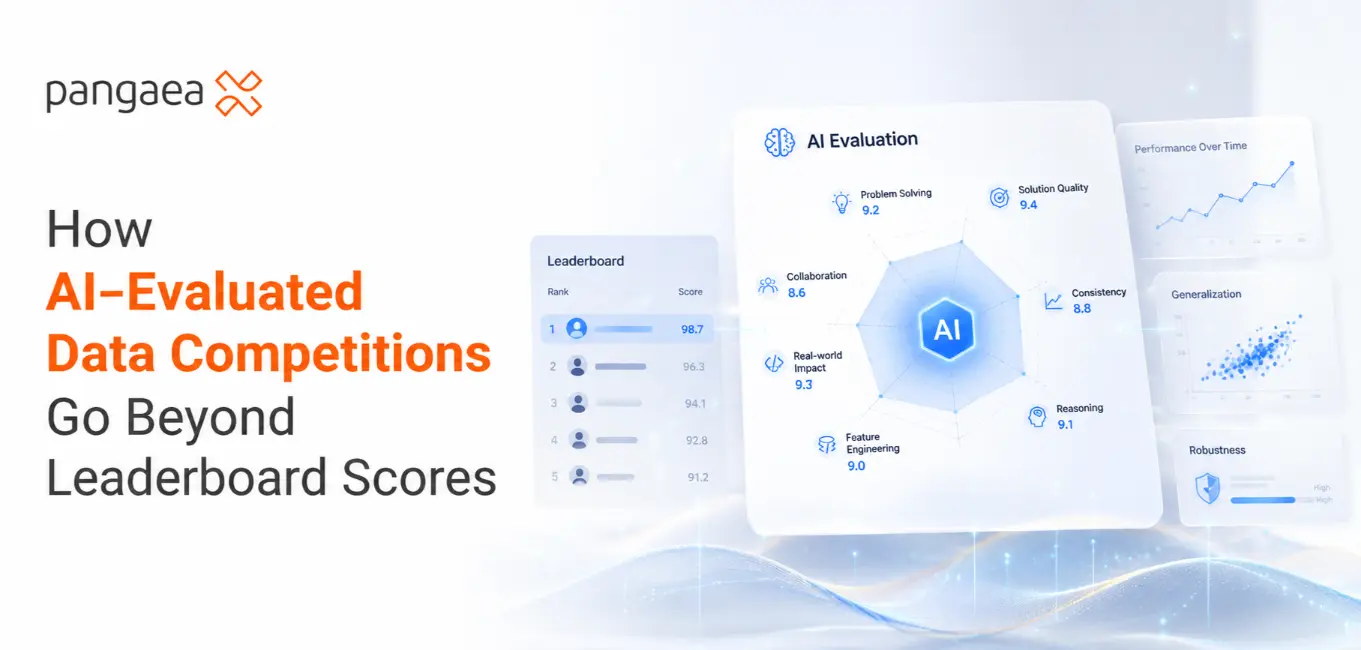
The Leaderboard Is One Output, Not the Whole Evaluation
A leaderboard still has a role. It creates a visible benchmark and helps participants understand how their performance compares with others.
However, rank should not be treated as a complete skill profile. Two people can achieve similar scores through different methods. One may demonstrate strong technical execution but limited explanation. Another may show clear business reasoning but make an avoidable implementation error.
The underlying evaluation is therefore more informative than the final position. This is also why data competitions can reveal skills that resumes cannot, particularly when the competition records the participant's reasoning and performance rather than only participation.
What Should Participants Check Before Joining?
The phrase "AI-evaluated" does not by itself confirm that a competition is useful. Before joining, participants should examine:
- What skills the challenge claims to assess
- Whether the evaluation criteria are explained
- Whether open-ended answers are scored against a defined rubric
- Whether feedback identifies specific strengths and gaps
- Whether participants can understand or challenge unexpected results
- Whether the task resembles the type of work they want to practise
- Whether the result can be shared as credible evidence of performance
Trustworthy AI evaluation should be valid for its intended purpose, consistently applied and transparent enough for participants to understand what the result means.
How CompeteX Uses AI-Evaluated Challenges
CompeteX offers AI-evaluated data competitions across machine learning, SQL, Python, data analytics, business intelligence and AI innovation.
Its challenge formats include knowledge-based questions and scenario-based tasks. Its evaluation can verify output, accuracy and efficiency, benchmark solutions against reference approaches, and assess decision logic in scenario-based responses.
This makes the platform relevant to participants who want to practise more than one type of data skill. A Python debugging challenge may emphasise technical correctness, while a revenue-diagnosis scenario may focus more heavily on evidence, reasoning and recommended actions.
The result is intended to help participants understand their performance, earn certificates for completed challenges and present competition outcomes as part of their professional profile.
How to Use Competition Feedback
After completing an AI-evaluated challenge, do not stop at the overall score. Review the result as a development plan:
- Identify the lowest evaluation dimension
- Compare the feedback with your original reasoning
- Rework the task without looking at the reference answer
- Document what you changed and why
- Choose the next challenge based on the gap you want to address
This turns each competition into evidence of both performance and improvement.
Frequently Asked Questions
Are AI-evaluated data competitions only for data scientists?
No. They can assess SQL, Python, data analysis, business intelligence, visualization, machine learning and business reasoning. The right competition depends on the skill a participant wants to practise or demonstrate.
Can AI evaluate an open-ended data answer?
It can evaluate an open-ended response when the task has a clear rubric, reference criteria and defined assessment dimensions. The result should still be interpreted within the limits of that rubric.
Is AI evaluation better than manual judging?
The formats have different strengths. AI can support consistent and rapid evaluation at scale, while qualified human reviewers may be needed for ambiguous, high-stakes or disputed decisions. A competition should choose the approach that fits the task.
Conclusion
AI-evaluated data competitions expand what a challenge can assess. They can examine not only whether an answer is correct, but how the participant reasoned, selected a method, handled constraints and translated analysis into action.
The leaderboard remains useful, but it is only one visible result. The greater value comes from the evaluation detail and feedback behind it.
Professionals who want to test these capabilities can explore current SQL, Python, analytics, machine-learning and scenario-based challenges on CompeteX.