
Introduction
A resume tells an employer what you say you can do. A data competition shows what you actually do when given a real problem, a real dataset, and a deadline.
That gap between claimed and demonstrated skill has always existed. In 2026, it has become a genuine hiring crisis.
The Resume Problem Is Getting Worse
The numbers paint a clear picture of how broken the resume-first hiring model has become:
- AI screening systems now reject 75% of resumes without any human review
- 36% of job seekers admit to listing skills they don't yet have, with AI being the most faked skill at 36%
- 65% of employers have already shifted to skills-based screening, moving away from resume and GPA-based filters
- 70% of technology leaders say the volume of AI-generated resumes has made it harder to assess candidates quickly and confidently
The resume was never a perfect signal. It's now actively unreliable. Hiring managers for data roles know this. The response across the industry has been to look for evaluation methods that test what candidates can actually do.
Data competitions are one of the clearest answers to that problem.
What a Resume Cannot Show
A resume can tell you someone knows Python. It cannot tell you how they use Python when the data is incomplete, the problem is ambiguous, and the clock is running.
The skills a resume structurally cannot reveal:
- How a candidate handles messy, real-world data with missing values and inconsistent formatting
- How they scope an open-ended problem when no one tells them where to start
- How their solution holds up when benchmarked against others solving the same problem simultaneously
- How quickly they move from problem framing to working output
- Whether their stated proficiency matches actual performance under real conditions
These are precisely the skills that determine whether a data professional succeeds on the job. A list of tools and a bullet point summary of past roles captures none of them reliably.
What Competitions Reveal Instead
A well-structured data competition creates the conditions for skill to show up objectively.
What competition performance demonstrates:
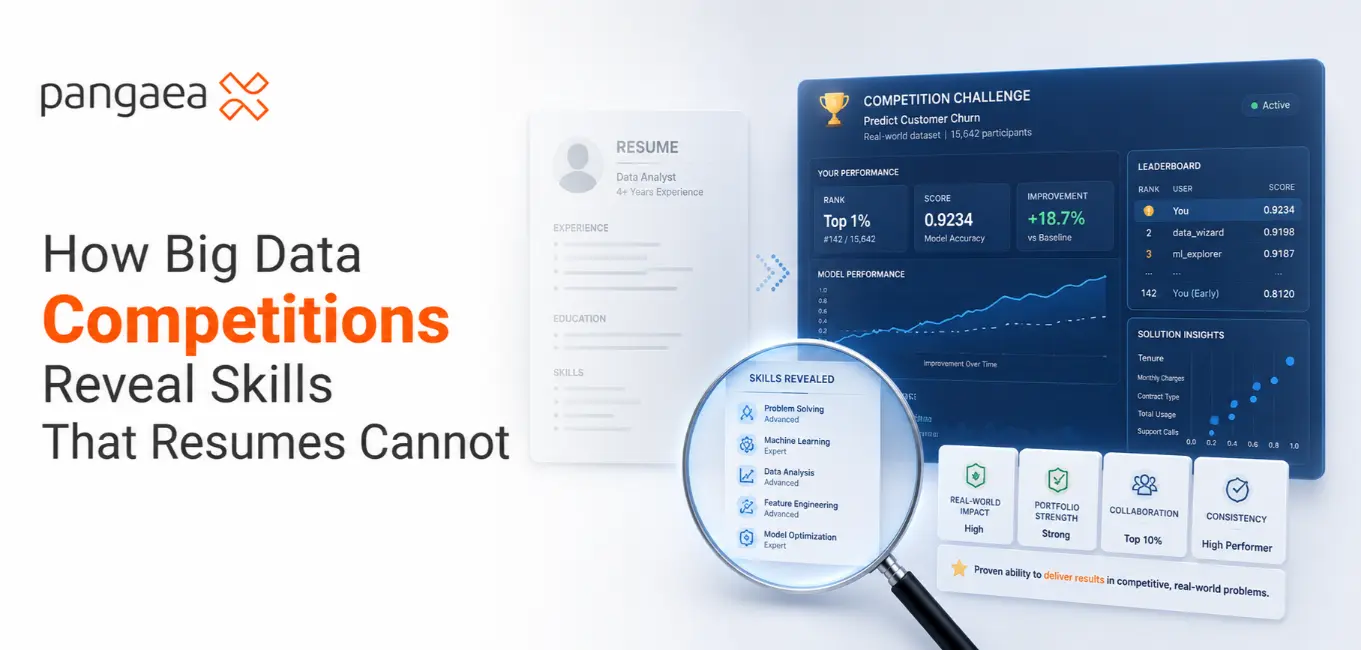
Applied problem-solving under constraints. Competitions present real datasets, unclear paths forward, and fixed deadlines. How a participant navigates that combination reveals more about their working style than any interview question.
Benchmarked ability. A leaderboard rank is a direct comparison against every other participant attempting the same problem. It answers the question "how good is this person?" with an actual number rather than a self-reported claim.
Consistency across domains. A participant who performs well across ML, SQL, and scenario-based analytics challenges demonstrates breadth that a resume listing those skills can only claim.
Judgment, not just execution. Scenario-based challenges in particular, where there is no single correct answer and evaluation is based on how the candidate reasons through a business problem, test the kind of judgment that separates analysts who can work autonomously from those who need constant direction.
Verified output. A certificate from a scored competition is attached to a real result. It is not a credential awarded for attending a course or passing a multiple-choice test.
The Specific Skills Competitions Surface
Different challenge formats reveal different things. Understanding what each type shows is useful both for candidates building a profile and for hiring teams evaluating one.
SQL challenges reveal how cleanly and efficiently a candidate queries data, structures joins, and handles edge cases. Basic proficiency is easy to fake on a resume. Query structure under evaluation is not.
Python challenges test data manipulation, algorithmic thinking, debugging, and the ability to produce working code against a specification with real data.
Classification and predictive modelling challenges surface how a candidate approaches feature engineering, model selection, validation strategy, and the trade-offs between accuracy and interpretability.
Scenario-based challenges go furthest in revealing strategic thinking. Given a business context and a dataset, candidates must define the problem, choose their approach, and defend their recommendation. These challenges reveal whether a candidate can think like an analyst rather than just execute like a technician.
Why This Matters More in 2026
Technical assessments are replacing resumes as the primary hiring signal in tech hiring, improving quality of hire and reducing bias.
AI, ML and data science roles totalled 49,200 postings in 2025, up 163% from 2024. Demand is rising faster than the supply of verifiable talent. Hiring managers in data are not struggling to find people who claim the right skills. They are struggling to find people who can demonstrate them.
Competition results address this directly. They are externally validated, objectively scored, and comparable across candidates in a way that no resume can be.
For Data Professionals: Building a Competition Profile That Works
A competition profile is most useful when it is intentional, not just a record of participation.
What makes a competition record meaningful to employers:
- Consistency across multiple challenges rather than a single result
- Performance in challenges relevant to the roles you're targeting
- Certificates that are verifiable and attached to real scored outcomes
- Improvement over time, which signals learning ability as well as current skill level
CompeteX is PangaeaX's data competition platform built specifically for data professionals. Challenges span Machine Learning, Business Intelligence, Data Analytics, Python, SQL, Predictive Analytics, Data Engineering, and AI Innovation, covering the full range of skills that data roles demand. AI-powered evaluation ensures scoring is consistent and comparable across all participants, and verified certificates are shareable directly from the platform.
Every challenge on CompeteX is individually scored and leaderboard-ranked, producing exactly the kind of objective, externally validated performance record that a resume cannot replicate. For data professionals at any experience level, it's a direct route to building credibility that holds up under scrutiny.
The Bottom Line
Resumes describe what you say you can do. Competitions prove it.
In a hiring market where self-reported skills are increasingly untrustworthy and AI screening has made the resume an even blunter instrument, verifiable performance on real data problems is one of the strongest signals a data professional can put in front of an employer.
The professionals building that record now will be easier to hire, faster to evaluate, and harder to overlook.