
Introduction
For most of the last decade, skill assessment in data hiring followed a familiar pattern: a resume screen, a take-home assignment, a technical interview with a whiteboard or a shared coding environment, and then a decision. The process was slow, inconsistent, and heavily dependent on who happened to be in the room.
AI has changed most steps of that process already. Resume screening is largely automated. Assignments are being replaced by structured assessments. And now the interview itself is being reimagined, not just recorded and analysed after the fact, but conducted by AI in real time.
AI-led conversational interviews are the newest and most significant development in how data professionals are evaluated. Understanding how they work, what they actually reveal, and how to perform well in them is quickly becoming essential knowledge for anyone in the data field.
Why Traditional Skill Assessments Fall Short for Data Roles
Data work is inherently contextual. The same dataset can lead to completely different recommendations depending on the business context, the question being asked, and the judgment of the analyst interpreting it.
Traditional assessments struggle to capture this because they are built around right and wrong answers:
- MCQ tests reward recall, not reasoning
- Timed coding challenges measure speed under pressure, not real-world problem-solving
- Static portfolios show what was built, not how the thinking unfolded
- Resume-based screening tells you what someone claims, not what they can do
The skills that make a data professional genuinely valuable, reasoning through ambiguity, communicating findings clearly, connecting data to business outcomes, are invisible to most conventional screening formats.
What AI-Led Conversational Interviews Do Differently
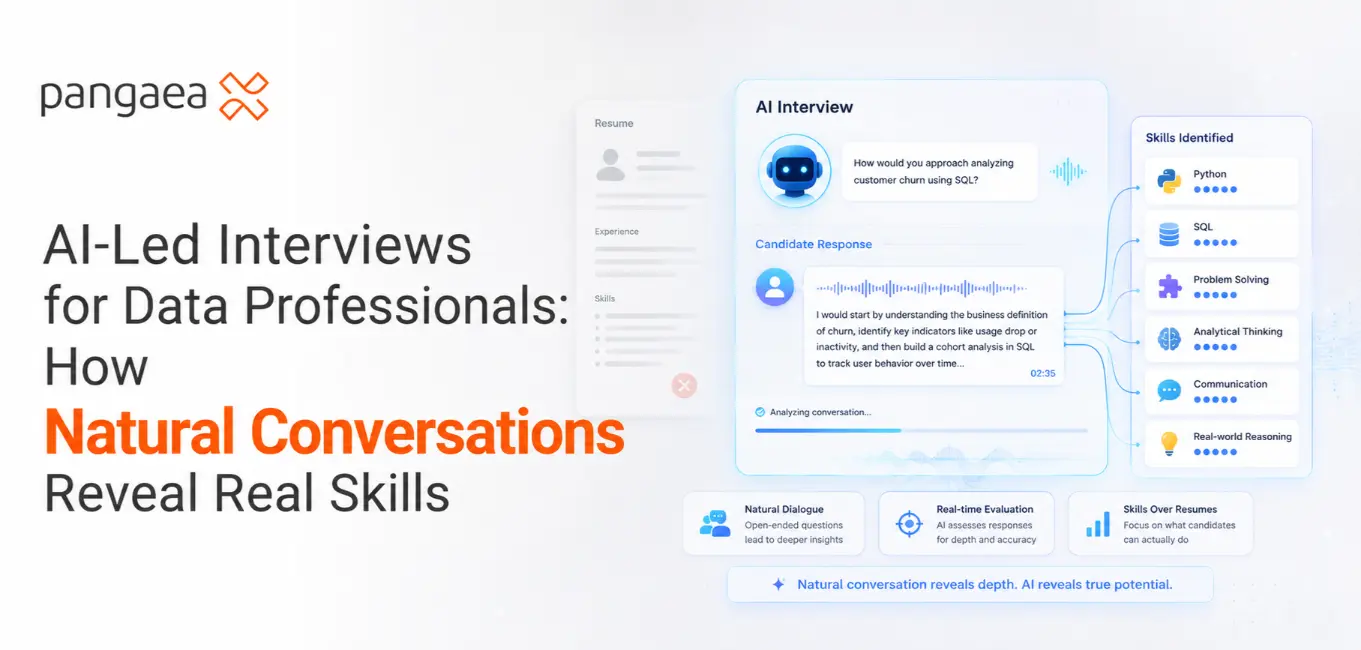
An AI-led interview is a live, two-way conversation between a candidate and an AI system. It is not a quiz. It is not a pre-recorded video with scripted prompts.
What makes it different:
- The AI listens and adapts in real time based on what the candidate says
- It asks follow-up questions when an answer is incomplete or when a stronger answer is possible
- It probes deeper into areas where the candidate shows strength or uncertainty
- It evaluates consistency across the full conversation, not just individual answers in isolation
- A human interviewer might miss that your answer to one question contradicts what you said earlier. The AI does not.
For data roles specifically, this format surfaces things that static assessments cannot: how a professional reasons through a problem, how they communicate technical concepts, how they handle uncertainty, and whether their real knowledge matches what they've stated on their profile.
What Conversational AI Assessment Reveals
Depth of understanding vs. surface familiarity. Anyone can say they know machine learning. A conversational AI can follow up: how did you choose that model? What did you validate against? What would you have done differently? Surface familiarity runs out of road quickly under real follow-up.
Communication ability. Data professionals are not just expected to analyse. They're expected to explain. A conversational format directly evaluates how clearly and confidently someone communicates technical ideas, which a written test never can.
Behavioral signals. How a candidate approaches a question they're unsure about, whether they acknowledge the limits of their knowledge, how they reason out loud through an unfamiliar problem, all of these reveal professional maturity that credentials alone cannot show.
Consistency. AI interviews evaluate candidates across the entire session. A candidate who gives strong answers on some topics but inconsistent answers on others produces a more honest profile than one who rehearsed a handful of strong responses for a human panel.
The Bias and Fairness Advantage
Traditional interviews carry well-documented bias risks. Interviewers make unconscious judgments based on name, accent, appearance, educational background, and personal rapport. These factors have nothing to do with analytical ability.
AI-led conversations shift the evaluation focus to demonstrated competence rather than perceived fit:
- Every candidate faces the same depth of questioning
- Evaluation criteria are consistent and tied to skill, not presentation
- Background, location, and educational pedigree do not influence the conversation
- The result reflects what the candidate knows and how they think, not who they remind the interviewer of
For data professionals from non-traditional backgrounds or those without brand-name institutions on their resume, this is a meaningful equaliser.
Adoption Is Already Happening
This is not a theoretical shift. Over 40% of enterprise companies are now piloting or deploying AI in their interview process, up from under 15% in 2023 (Gartner, 2025). In IT, data science, and DevOps roles specifically, AI interviews are being used to narrow down candidates who meet both technical and communication benchmarks.
The consensus in 2026 is not whether AI-led assessment works. It's how to design it well: with transparency, clear evaluation criteria, and human oversight at key decision points.
How AuthenX Applies This for Data Professionals
AuthenX is PangaeaX's AI-powered skill authentication platform built specifically for data professionals. After an initial smart screening stage that analyses your profile and portfolio, the process moves to an AI Interview.
The AuthenX AI Interview is:
- Conversational, not task-based. No timed quizzes, no coding sandboxes, no scripted prompts
- Available 24/7, so you engage on your schedule rather than fitting a recruiter's calendar
- Behaviorally focused, evaluating how you reason and communicate, not just whether you produce the right output
Once complete, you receive an AI Performance Report, an Authenticated Badge and Certificate, and a Smart Ranking. These are shareable on your profile and carry more weight than a self-reported skill list precisely because they reflect a real conversational assessment, not a credential you purchased or a test you memorised for.
For data professionals building a credible profile in a market where claimed skills are increasingly distrusted, AuthenX produces the kind of verified signal that holds up to scrutiny.
What This Means for Data Professionals
If AI-led interviews are becoming a standard part of how data talent is evaluated, the preparation required is different from what worked before.
What to focus on:
- Being able to articulate your reasoning, not just your conclusions
- Explaining technical decisions in plain language, as if to a smart non-technical person
- Being honest about uncertainty rather than bluffing through gaps
- Thinking out loud through unfamiliar problems rather than going silent
The professionals who perform best in conversational AI assessments are those with genuine depth. There is no script to memorise that survives real follow-up questions. The format rewards actual understanding, which is exactly why it's replacing static tests as the evaluation method of choice for data roles.
The Bottom Line
Natural conversation reveals things that tick-box assessments cannot. For data roles, where judgment, communication, and reasoning matter as much as technical execution, the shift toward AI-led conversational interviews is a more honest way to evaluate real skill.
The professionals who understand this shift and can perform confidently in conversational assessment formats will be better positioned in a hiring market that is moving away from credential-first screening toward demonstrated ability.