
Introduction
Hiring data talent has always been harder than it looks on paper. Resumes are easy to polish. Interviews test nerves as much as skill. Take-home assignments are inconsistent and time-consuming to evaluate.
More companies are now turning to a different signal: competition performance. And the approach is gaining ground fast.
The Problem With Traditional Data Hiring
The core challenge is straightforward. When everyone lists the same tools and frameworks on their resume, the resume stops being a useful filter. And technical interviews, while better than nothing, are artificial environments that rarely reflect how a candidate actually works.
What hiring managers for data roles really want to know is:
- Can this person solve a messy, ambiguous data problem under real constraints?
- How do they think when the path forward isn't obvious?
- How does their ability compare to others at a similar level?
Traditional hiring methods struggle to answer all three. Data competitions do.
Why Competition Results Work as a Hiring Signal
Competition performance gives employers something most hiring tools don't: an objective, externally benchmarked measure of applied skill.
What a competition result tells a recruiter:
- The candidate can work with real datasets, not just curated tutorial data
- Their solution was ranked against others attempting the same problem, under the same constraints
- They can deliver output to a deadline without being walked through every step
- Their performance is quantified, not self-reported
As one analysis of competition-based hiring put it: companies can conduct a completely merit-based evaluation of potential employees, where applicants have a chance to demonstrate ability while going through the recruiting process.
This matters especially for data roles where the gap between claimed and actual skill is often significant.
How Companies Are Using Competitions to Recruit
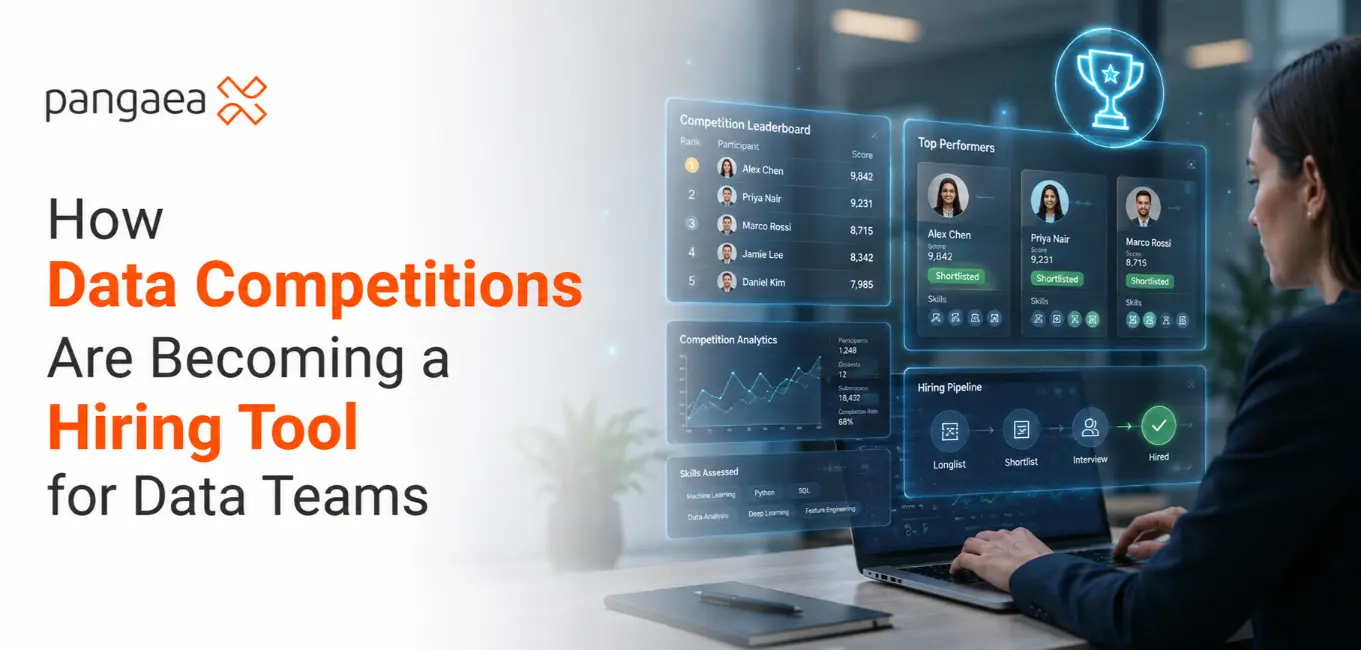
Sponsored competitions are the most direct version. A company funds and designs a challenge around a real business problem, then uses the results to identify candidates to contact. Participants may not even know they are being evaluated for a position. The company receives solutions to a genuine problem and a ranked list of performers to reach out to.
This model has existed for over a decade but is becoming more common as data roles multiply and the cost of bad hires in technical functions rises.
Leaderboard sourcing is a passive version of the same idea. Recruiters browse public competition results and profiles on competition platforms to identify high performers, then reach out directly. A candidate ranked in the top 5% of a relevant challenge is a warmer signal than a LinkedIn profile with the same keywords.
Portfolio screening is how competition history feeds into the broader hiring process. Candidates who have competed regularly develop a body of work that shows how they approach problems across different domains and difficulty levels. This is increasingly valued alongside or instead of traditional portfolio projects.
What Makes a Competition a Good Hiring Tool
Not every competition translates cleanly into a hiring signal. The format matters.
Competitions that work well for hiring evaluation:
- Individual challenges, not team events. Team competitions test coordination and presentation as much as individual analytical ability. Hiring managers want to evaluate the person, not the team.
- Objective scoring, not subjective judging panels. A ranked leaderboard based on accuracy or model performance is more trustworthy than a panel that may reward presentation skills.
- Real or realistic data, not simplified tutorial datasets. The challenge should reflect the kind of data the role will involve.
- Measurable, reproducible results that can be reviewed and compared across candidates.
This is precisely why multi-day hackathons, while valuable for some purposes, are not ideal hiring filters for data roles. They emphasise stamina, presentation, and group coordination rather than isolating individual analytical decision-making. The shift in the industry has been toward shorter, sharper, individually measurable challenges that mirror how data professionals actually work.
What This Means for Data Professionals
If companies are using competition results to find candidates, then the competition profile becomes part of the job application whether or not a candidate is actively competing for visibility.
Practical implications:
- A history of consistent competition participation signals engagement with the field, not just formal employment history
- Strong performance in challenges relevant to a target role (ML, SQL, BI, data analytics) is evidence that transfers directly to job applications
- Certificates and verified rankings are more credible than self-reported skill lists, especially in a market where AI-optimised resumes have made keyword matching less reliable
- Entry-level professionals can bypass the experience catch-22 by demonstrating applied ability through competition results rather than waiting for an employer to take a chance on them first
Recruiters in 2026 use competition results to vet candidates, and employers look at leaderboard positions alongside or instead of traditional credentials. That pattern is only becoming more common as the number of competition platforms and participants grows.
CompeteX and the Hiring Connection
CompeteX is PangaeaX's data competition platform built specifically for data professionals. Challenges cover Machine Learning, Business Intelligence, Data Analytics, Python, SQL, Predictive Analytics, Data Engineering, and AI Innovation. AI-powered evaluation and instant feedback mean results are consistent and comparable across participants rather than dependent on who happened to be judging.
The challenge format is specifically designed to produce the kind of individual, objectively scored performance record that makes sense as a hiring signal. Strong performers build a visible, verifiable track record of applied ability that speaks for itself when companies are looking for data talent.
The Bottom Line
Data competitions are not just a learning tool. They have become a talent discovery mechanism for companies that need to find skilled data professionals in a market where traditional signals are increasingly unreliable.
For hiring teams, sponsored competitions and leaderboard sourcing offer a more reliable filter than resume screening alone. For data professionals, a strong competition record is now part of the professional identity that gets noticed.
The shift is already underway. The data teams that understand it earliest will have an advantage on both sides of the hiring equation.