
Introduction
Business intelligence tools haven't changed this fast before.
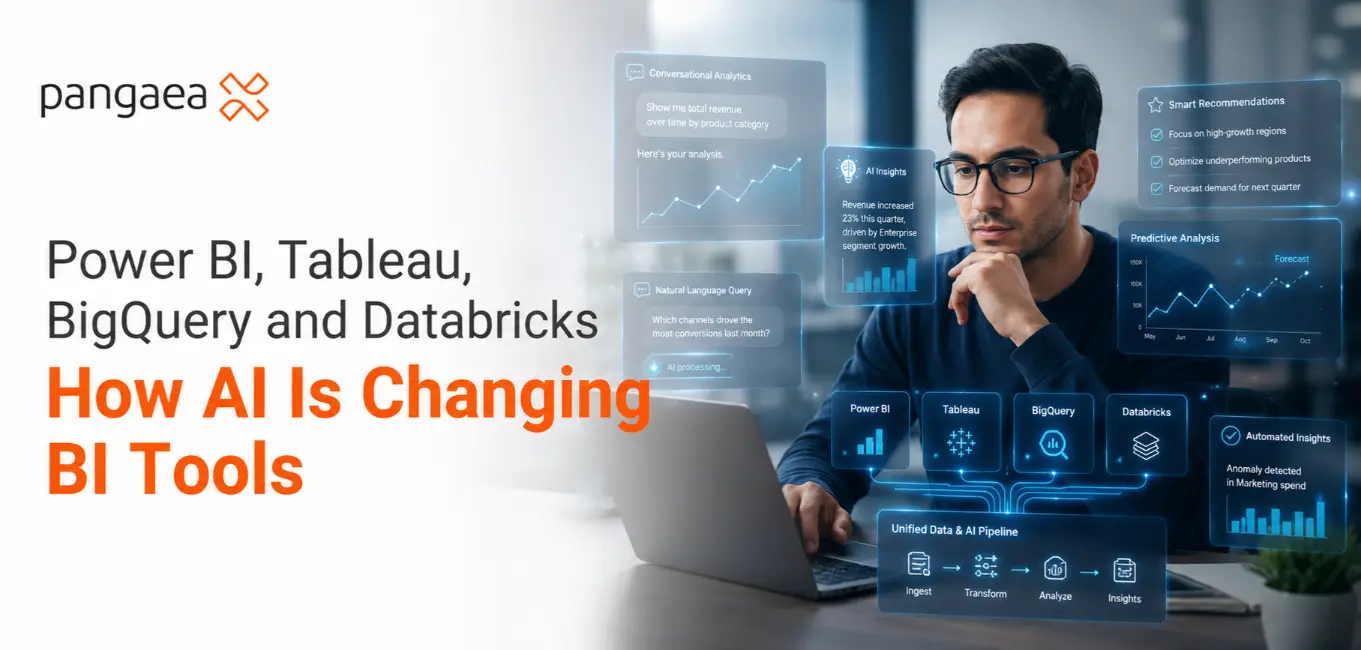
Power BI, Tableau, BigQuery, and Databricks have all added significant AI capabilities in the last 12 to 18 months. Natural language querying, AI-generated insights, copilots, and autonomous agents are no longer roadmap items. They're in production.
For data professionals, this changes what these tools can do and what skills are expected when working with them. Here's what's actually changed in each platform.
Power BI: Copilot and the Microsoft Fabric Era
Microsoft has tied Power BI's AI future directly to Microsoft Fabric, its unified data platform. The result is a tighter integration between data storage, computation, and reporting than was possible before.
What's new in 2026:
- Power BI Copilot generates DAX queries in DAX Query View, reducing manual formula writing
- Direct Lake mode via Microsoft Fabric reads Delta Parquet files in OneLake directly, delivering import-mode performance without the need to duplicate data
- Quick Insights, Key Influencers, and Anomaly Detection surface patterns automatically for business users
- Azure ML integration enables advanced modelling scenarios within Power BI workflows
- Microsoft 365 customers with Copilot licences get Power BI Copilot integration included in their existing ecosystem
The honest limitation:
Copilot depends heavily on well-structured datasets. It often struggles with complex or poorly governed data, which means data quality and model design remain as critical as ever.
Tableau: Salesforce Agents and Tableau Next
Tableau's AI strategy is fully tied to the Salesforce ecosystem. This means Tableau is no longer just a visualisation tool; it's becoming a data layer that AI agents in other Salesforce products can query.
What's new in 2026:
- Tableau Pulse delivers AI-generated metric summaries proactively via Slack or email, without users needing to open a dashboard
- Tableau Next, announced at Salesforce TDX 2025, is a metadata-first BI layer running natively on Salesforce Data Cloud with a semantic layer exposed to Agentforce AI agents
- Agentforce integration equips Salesforce's AI agents with analytics skills so sales, service, and marketing workflows get data-driven answers without switching tools
- Ask Data enables natural language querying within Tableau's existing environment
Who benefits most:
Organisations already running Salesforce CRM. Tableau Pulse and Tableau Next are most powerful inside the Salesforce and Agentforce ecosystem. Outside it, the value of these integrations is more limited.
The core shift:
Both Tableau and Power BI have moved their roadmaps from "build more visuals" to "build more autonomous analytics agents." The choice between them in 2026 is increasingly a choice between the Microsoft AI ecosystem and the Salesforce AI ecosystem.
BigQuery: SQL-Native ML and Looker Integration
BigQuery's AI story operates at the data layer rather than the visualisation layer. Google has built ML capabilities directly into BigQuery's SQL interface, meaning analysts don't need to leave their query environment to run models.
What's new and relevant:
- BigQuery ML allows users to build and execute machine learning models using standard SQL commands, enabling forecasting and classification without separate ML tooling
- Looker integration sits on top of BigQuery with LookML defining business logic centrally, ensuring consistent metric definitions across all dashboards and users
- Sub-second queries on petabyte-scale datasets without moving data remain one of BigQuery's core technical strengths
- Google Cloud native architecture means everything is API-first and integrates directly with broader GCP services
What this means in practice:
BigQuery is strongest for organisations already on Google Cloud. Its embedded ML capabilities make it particularly valuable for analysts who want to run predictive models without separating their analysis and modelling environments.
Databricks: AI/BI and the Lakehouse Convergence
Databricks is taking the most architecturally ambitious approach. Rather than adding an AI layer on top of a BI tool, it's converging analytics, ML, and governance into one platform built on the Lakehouse.
What's new in 2026:
- Databricks AI/BI Genie is a no-code conversational analytics tool integrated directly into the Databricks platform. Users ask natural language questions and get grounded answers from governed data
- Genie MCP Server (Beta) allows any external AI agent to query Genie Spaces and Unity Catalog data using natural language and receive grounded responses
- Import BI workbooks (Beta) lets users add a Tableau or Power BI file to Genie Code, which then builds an AI/BI dashboard replicating those visualisations automatically
- Unity Catalog centralises governance, so the data, ML workflows, and analytics share the same execution environment without duplication
- October 2025 updates to Genie brought expanded conversational capabilities and tighter integration with the broader Databricks data and AI stack
The architectural difference:
Power BI and Tableau sit above the data platform as separate layers. Databricks AI/BI sits inside it. For organisations running their data engineering and ML on Databricks, this eliminates the governance and maintenance complexity that comes from replicating data into a separate BI tool.
Who it's for:
Teams already on Databricks for data engineering. It's not a standalone BI purchase and makes less sense outside the Databricks ecosystem.
What This Means for Data Professionals
The AI additions across all four platforms share a common thread: they reduce the time between a question and an answer for non-technical users. But they don't reduce the need for skilled professionals. They shift where that skill is applied.
Skills becoming more important:
- Data modelling and governance, because AI features only work well on clean, well-structured data
- Prompt engineering and natural language query design, particularly for Genie and Copilot workflows
- Semantic layer design, since LookML (Looker/BigQuery) and Tableau Next's metadata layer are where business logic lives
- Critical evaluation of AI-generated outputs, since text-to-SQL can produce queries that look correct but return wrong results when the model doesn't understand business context
Skills becoming less central:
- Manual DAX formula writing (Copilot handles more of this)
- Repetitive dashboard templating (AI agents are beginning to automate this)
- Basic query execution for standard reporting tasks
The professionals who will work most effectively with these platforms in 2026 are those who understand both the AI capabilities and their limitations, and who can build the data foundations (governance, semantic layers, clean models) that make those AI features reliable.
The Bottom Line
AI hasn't made BI tools simpler to understand. It's made them more capable and, in some ways, more demanding. The tools are doing more, but only when the data underneath is clean, governed, and well-modelled. That doesn't happen automatically.
At PangaeaX, the freelance data professionals on OutsourceX are already working with these changes in practice. Power BI Copilot workflows, Tableau Pulse setups, BigQuery ML pipelines, and Databricks Genie implementations are live skills in the talent pool, not theoretical knowledge. Businesses that need to move fast on any of these platforms can find and hire freelance data experts who are already ahead of the curve.