
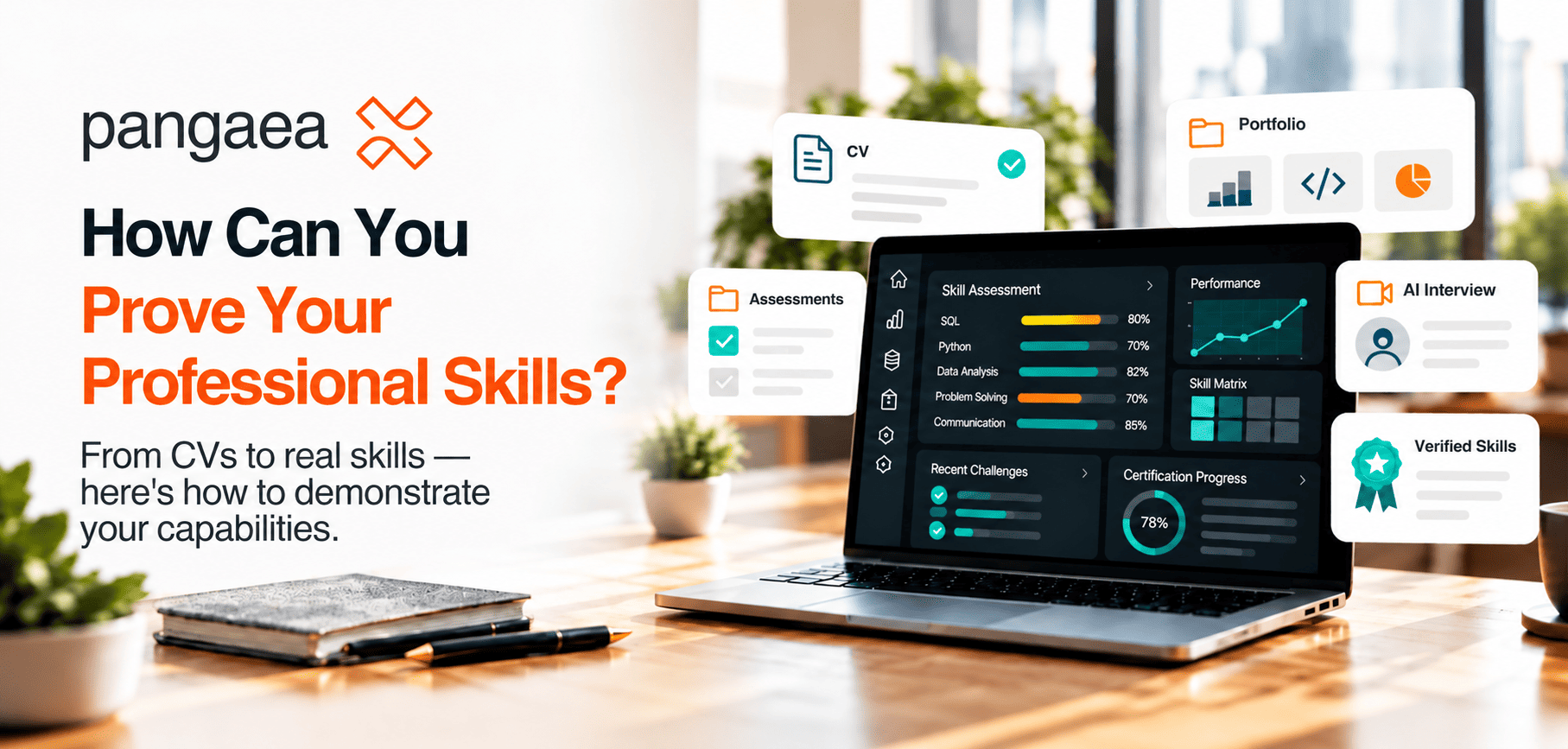
Having the right skills is one thing. Being able to demonstrate those skills clearly is another.
Whether you are a software developer, data analyst, data scientist, engineer, or another technical professional, your CV may only tell part of the story.
You might list Python, SQL, machine learning or data analytics as skills. You might have several years of experience and a portfolio of projects.
But when someone asks, “How can you prove you actually have these skills?”, the answer requires more than a list of technologies.
Professional skills can be demonstrated through a combination of work experience, portfolios, practical projects, assessments, technical challenges, interviews and skill verification.
The strongest approach depends on the skill and the context in which you need to demonstrate it.
What Does It Mean to Prove a Professional Skill?
Proving a professional skill means providing credible evidence that you can apply that skill in practice.
For example, saying:
“I have advanced SQL skills.”
is a claim.
Showing how you used SQL to analyse a complex dataset, explaining your queries and successfully completing a structured SQL assessment provides additional evidence.
This distinction matters because professional skills are often broader than knowledge alone.
Someone may know Python syntax but struggle to use Python to solve a real-world problem.
Someone may understand machine-learning concepts but have limited experience building and evaluating models.
Demonstrating a skill therefore involves showing knowledge, application and reasoning.
If you want to understand the broader concept behind verifying professional capabilities, see our guide to what skill authentication is and how professional skills can be verified.
Why Is It Important to Demonstrate Your Skills?
Professional profiles are increasingly built around skills.
A CV might contain dozens of keywords. A LinkedIn profile might list numerous technologies. A portfolio might contain several projects.
But simply listing a skill does not tell someone how well you can use it.
Consider two professionals who both list SQL on their CV.
One may have used SQL occasionally for simple reporting.
The other may have several years of experience working with complex analytical queries and large datasets.
Both profiles could contain the same keyword.
The difference becomes clearer when they are asked to demonstrate their capability.
This is why evidence matters.
For professionals, demonstrating skills can make their experience easier to understand.
For organisations, it can provide additional information when evaluating technical talent.
What Are the Best Ways to Demonstrate Professional Skills?
There is no single method that proves every professional skill.
A stronger approach is usually to combine different forms of evidence.
Show Relevant Work Experience
Professional experience is one of the most common forms of evidence.
Instead of simply writing:
Python — 5 years
a stronger description explains how Python was used.
For example:
Used Python and Pandas to automate data-processing workflows and analyse operational datasets.
This gives context to the skill.
When describing your experience, focus on:
- what you worked on
- which skills you used
- what problems you solved
- what you produced
- what the outcome was
Experience becomes more meaningful when the actual application of the skill is clear.
Build a Professional Portfolio
A portfolio can provide tangible evidence of previous work.
For technical professionals, this might include:
- software projects
- data analysis projects
- dashboards
- machine-learning models
- GitHub repositories
- case studies
- technical documentation
- automation projects
A strong portfolio should explain more than what you built.
It should also explain:
What was the problem?
What was your approach?
Which technologies did you use?
What challenges did you encounter?
What was the outcome?
This allows someone reviewing your portfolio to understand your technical thinking rather than simply looking at the final result.
Complete Practical Skills Assessments
A practical assessment can provide evidence of what you can do under defined conditions.
For example, a SQL assessment might ask you to:
- query a database
- join multiple tables
- aggregate data
- use window functions
- identify trends
- solve an analytical problem
A Python assessment might evaluate:
- programming fundamentals
- data manipulation
- debugging
- automation
- problem-solving
- practical application
Practical assessments can therefore complement a CV by evaluating the actual application of a skill.
Take Technical Challenges
Technical challenges provide another way to demonstrate capability.
Rather than simply answering questions about a technology, you may be asked to solve a specific problem.
For example:
Analyse a dataset and identify the three most important trends.
Or:
Write a SQL query that identifies customers whose spending increased over three consecutive months.
The value of a challenge is that it can demonstrate how you approach a problem, rather than simply whether you recognise the correct terminology.
Explain Your Technical Decisions
Being able to explain your work is an important part of demonstrating professional capability.
Imagine two people have created similar data-analysis projects.
One can explain:
- why they selected a particular method
- how they cleaned the data
- why they chose a specific model
- what limitations existed
- how they validated their results
The other can only describe the final output.
The ability to explain decisions provides additional evidence of understanding.
This is one reason technical interviews remain useful alongside practical assessments.
Use Certifications as Supporting Evidence
Certifications can demonstrate structured learning or achievement against defined requirements.
They can be useful evidence, particularly when the certification is relevant to the skill being claimed.
However, a certification does not necessarily demonstrate every aspect of practical ability.
For example, someone may have completed a certification related to data analytics while having very different levels of practical experience.
This is why certifications can work particularly well when combined with:
- projects
- portfolios
- practical assessments
- professional experience
- technical interviews
The credential provides one type of evidence. Demonstrated capability provides another.
Use Skill Verification or Authentication
Another approach is to use a structured skill verification or authentication process.
Rather than relying solely on self-reported information, the process can combine different forms of evidence.
For example:
Professional experience → Portfolio evidence → Technical assessment → Practical evaluation → Technical interview → Authenticated skill profile
The exact process can vary depending on the platform and the skill being evaluated.
The important principle is that the professional's claim is supported by additional evidence.
For a deeper explanation of this approach, read What Is Skill Authentication? A Guide to Verifying Professional Skills.
How Do You Prove Technical Skills on a CV?
Your CV should not simply contain a long list of technologies.
Instead of:
Skills: Python, SQL, Tableau, Machine Learning, AWS
consider connecting skills to actual work.
For example:
Data Analytics: Used SQL and Python to analyse customer behaviour across multiple datasets and developed dashboards to communicate key trends.
This provides context around the skill.
A useful structure is:
Skill → Application → Problem → Outcome
For example:
SQL: Developed analytical queries across multiple datasets to identify customer retention trends and support monthly reporting.
This makes the skill more meaningful to the person reviewing your CV.
How Do You Prove Skills You Have Learned Independently?
Not every professional skill comes from a university degree or formal training programme.
Professionals increasingly learn through:
- online courses
- personal projects
- open-source contributions
- technical communities
- self-directed study
- experimentation
- professional experience
If you learned a skill independently, create evidence around it.
For example, if you learned Python independently, you could:
- Build practical projects.
- Publish selected work in a portfolio.
- Document your approach.
- Complete relevant technical assessments.
- Participate in challenges.
- Demonstrate your knowledge through a technical interview.
The objective is to move from:
“I learned Python.”
to:
“Here is evidence of what I can do with Python.”
That distinction is particularly important when you don't have years of formal employment experience in the skill.
Can AI Interviews Help Verify Professional Skills?
AI-powered interviews can be used as part of a structured skill-verification process.
Depending on how the system is designed, an AI interview can explore:
- technical knowledge
- problem-solving
- project experience
- reasoning
- communication
- responses to role-specific scenarios
For technical professionals, this can complement practical assessments and portfolio evidence.
However, an AI interview should be designed around the specific competency being evaluated.
A generic interview is less useful than one designed around the actual skills being authenticated.
For example, an authentication process for a Python developer should evaluate relevant Python knowledge and problem-solving rather than simply asking broad questions about software development.
What Is the Difference Between Showing Skills and Authenticating Skills?
Showing a skill and authenticating a skill are related, but they are not exactly the same.
A portfolio shows what you have worked on.
A CV describes your experience.
A certification documents a formal achievement.
An assessment evaluates your capability.
An interview explores your knowledge and reasoning.
Skill authentication can bring multiple forms of evidence together to provide a more structured picture of capability.
This distinction is important because professionals often have plenty of information about their experience but fewer ways to make their actual capabilities easy to verify.
You can learn more about the concept in our guide to skill authentication and professional skill verification.
How AuthenX Helps Professionals Demonstrate Their Skills
AuthenX by PangaeaX is designed to help professionals move beyond simply listing skills on a CV.
Through structured skill authentication, portfolio screening and AI-powered interviews, AuthenX provides a way for professionals to demonstrate capabilities through an evaluation process.
For example, instead of simply listing:
Python — Advanced
a professional can go through an authentication process focused on the relevant technical capability.
This creates additional evidence that can sit alongside their existing professional profile.
The underlying idea is simple:
Don't just tell people what you know. Give them evidence of what you can do.
What Is the Best Way to Prove Your Professional Skills?
There is no single piece of evidence that proves every professional skill.
A stronger approach is to combine multiple forms of evidence:
Experience + Portfolio + Practical Assessment + Technical Interview + Skill Verification
The right combination depends on the profession, skill and purpose.
For a software developer, GitHub projects and coding assessments may be particularly relevant.
For a data analyst, SQL, Python, analytical case studies and technical interviews may provide useful evidence.
For a machine-learning professional, model development, evaluation, technical projects and interviews may be relevant.
The key is to make the connection between claimed skill and demonstrated capability as clear as possible.
Key Takeaways
- A CV can describe your skills, but evidence helps demonstrate them.
- Professional experience is stronger when you explain how you applied a skill.
- Portfolios provide tangible evidence of previous work.
- Practical assessments can evaluate specific technical capabilities.
- Technical challenges can demonstrate problem-solving.
- Interviews can explore reasoning and technical understanding.
- Certifications can provide useful supporting evidence.
- Skill verification and authentication can combine multiple forms of evidence.
- The strongest professional profile connects what you claim to what you can demonstrate.
Frequently Asked Questions
How can I prove my professional skills?
You can demonstrate professional skills through work experience, portfolios, practical projects, assessments, technical challenges, certifications, interviews and structured skill verification.
How can I prove my technical skills?
Technical skills can be demonstrated through practical projects, technical assessments, coding challenges, portfolios, interviews and other structured evaluations.
Is a portfolio enough to prove professional skills?
A portfolio can provide valuable evidence, but it may not demonstrate every aspect of a person's current capability. Practical assessments and interviews can provide additional evidence.
How do I prove skills that I learned by myself?
Build practical projects, document your work, create a portfolio, complete relevant assessments and participate in technical challenges or interviews.
Can certifications prove professional skills?
Certifications can demonstrate achievement against defined requirements, but practical projects and assessments can provide additional evidence of how someone applies their knowledge.
What is skill authentication?
Skill authentication is a process of verifying professional capabilities through structured evidence such as assessments, practical evaluation, portfolios and interviews.
Can employers use skill verification?
Yes. Employers can use structured skill verification and assessment as an additional layer when evaluating technical candidates.
What is AuthenX?
AuthenX is a PangaeaX platform focused on authenticating professional skills through structured evaluation, portfolio screening and AI-powered interviews.