
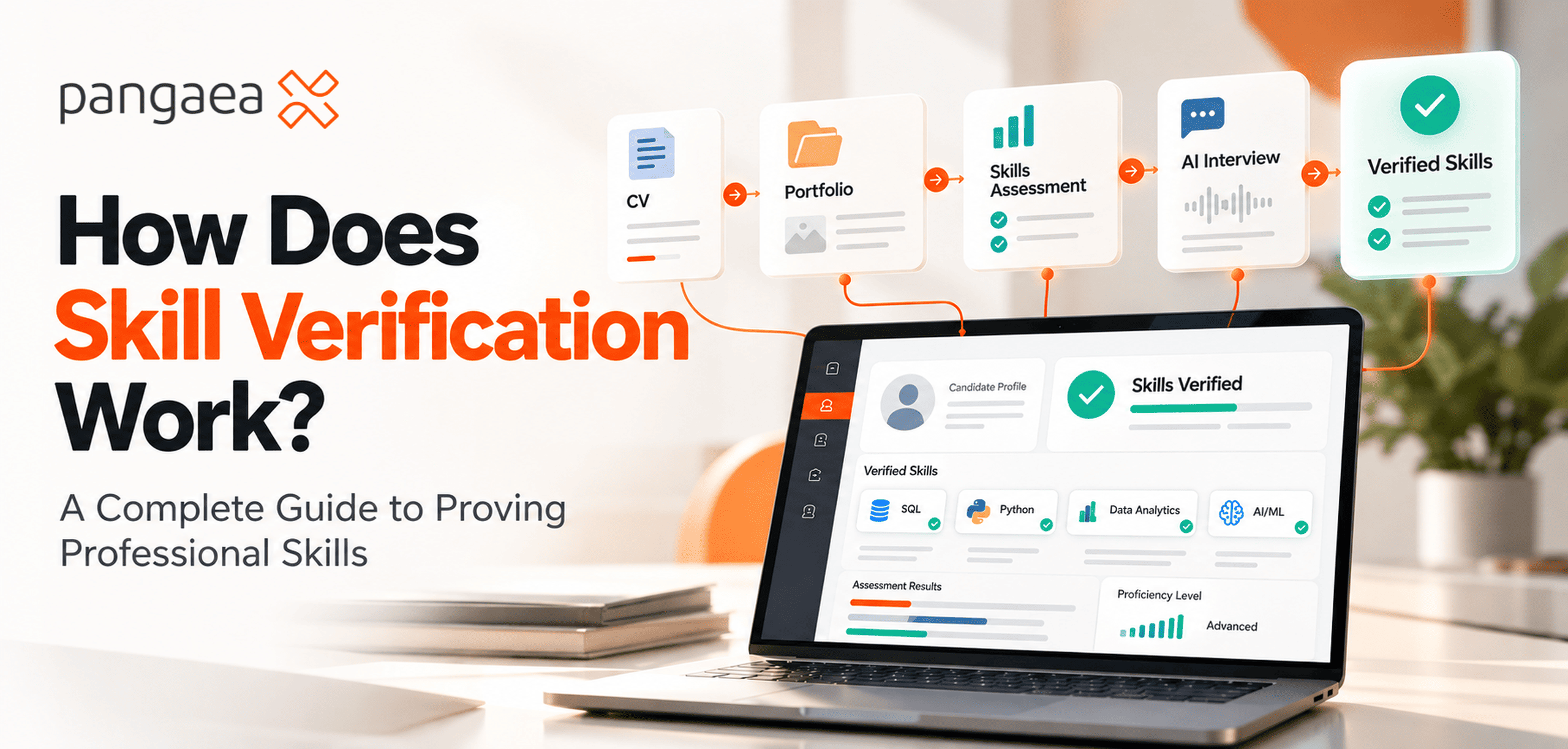
Skill verification is the process of evaluating evidence of a person's professional capabilities against defined skills or competencies. It can combine assessments, practical tasks, portfolios, interviews, certifications, and work experience to provide a clearer picture of what someone can actually do.
For professionals, skill verification can help turn a list of skills on a CV into evidence that can be evaluated.
For employers, it can provide another way to assess candidates beyond job titles, qualifications, and self-reported skills.
This is becoming increasingly relevant as the skills required for many jobs continue to change. The World Economic Forum's Future of Jobs Report 2025 identifies technological skills, including AI and big data, among the fastest-growing skill areas, while analytical thinking and other human skills remain important to employers. World Economic Forum
So, how does skill verification actually work, what can be verified, and how can employers and professionals use it?
What Is Skill Verification?
Skill verification is the process of checking whether a person can demonstrate a particular professional skill or competency using relevant evidence.
The evidence can take different forms depending on the skill.
For example, someone claiming advanced SQL skills could provide:
- Work experience
- SQL projects
- A portfolio
- A technical assessment
- Practical SQL challenges
- Interview responses
- A certification
Each provides a different type of evidence.
Skill verification brings relevant evidence together so that a person's claimed capabilities can be evaluated more systematically.
This is different from simply listing a skill on a CV.
If someone writes:
Python — Advanced
that is a claim.
If they complete a Python assessment, explain a project they built with Python, solve a practical problem, and demonstrate their technical reasoning in an interview, there is considerably more evidence to evaluate.
For more context, see How Can You Prove Your Professional Skills?.
Why Is Skill Verification Important?
Modern hiring often involves evaluating skills that are difficult to understand from a CV alone.
A candidate might list:
- Python
- SQL
- Machine Learning
- Data Analytics
- Generative AI
- Cloud Computing
But a skills list does not necessarily explain:
- How recently the skill was used
- How deeply the person understands it
- Whether they can apply it to real problems
- How independently they can work
- How their ability compares with the requirements of a particular role
This is where skill verification becomes useful.
It creates a framework for moving from:
Claim → Evidence → Evaluation
rather than relying entirely on:
Claim → CV → Assumption
How Does Skill Verification Work?
A structured skill verification process can be broken into several stages.
Step 1: Define the Skill
The first step is identifying exactly what needs to be verified.
"Data analytics" is broad.
A more specific skills framework might include:
- SQL
- Data cleaning
- Exploratory data analysis
- Statistics
- Data visualization
- Business analysis
- Data storytelling
Similarly, "Python" could be broken down into:
- Python fundamentals
- Pandas
- NumPy
- Data manipulation
- Data analysis
- APIs
- Automation
Defining the skill properly is important because you cannot meaningfully evaluate a capability that has not been clearly defined.
Step 2: Define the Competencies
The next step is determining what someone should actually be able to do.
For example, if SQL is the skill being verified, competencies might include:
- Writing SELECT queries
- Filtering and aggregating data
- Joining tables
- Using subqueries
- Working with window functions
- Optimizing queries
- Interpreting query results
This makes the verification process more specific.
A useful skills framework should distinguish between knowing about a technology and being able to use it.
Step 3: Gather Evidence
The next stage is gathering relevant evidence.
Depending on the process, this could include:
CV
Provides information about claimed experience.
Portfolio
Provides examples of previous work.
Certification
Provides evidence that a person has completed a defined credential or program.
Practical assessment
Tests specific skills or competencies.
Technical interview
Allows deeper exploration of knowledge, reasoning, and experience.
Work samples
Show how someone approaches realistic tasks.
The strongest approach is not necessarily to use every type of evidence.
Instead, the evidence should be relevant to the skill being evaluated.
Step 4: Evaluate the Skill
Once the evidence has been gathered, it needs to be evaluated against the defined competencies.
For example, a SQL verification process might evaluate:
| Competency | Evidence |
|---|---|
| SQL fundamentals | Technical assessment |
| Query writing | Practical challenge |
| Complex SQL | Practical assessment |
| Data interpretation | Case study |
| Technical reasoning | Interview |
| Previous application | Portfolio/work experience |
This creates a more structured picture of capability.
Step 5: Identify the Level of Capability
Skill verification can also distinguish between levels of proficiency.
For example:
Foundational
Understands basic concepts and can complete simple tasks.
Intermediate
Can independently apply the skill to common professional problems.
Advanced
Can solve complex problems, make technical decisions, and explain trade-offs.
Expert
Can handle highly complex problems, design approaches, mentor others, and make strategic technical decisions.
The exact levels should depend on the skill.
Not every professional needs to be an expert.
The important question is whether the person's capability matches the requirements of the role.
What Skills Can Be Verified?
Almost any professional skill can potentially be evaluated if there is a clear definition of what competence looks like.
For technical professionals, common examples include:
SQL
- Querying
- Joins
- Aggregation
- Window functions
- Query optimization
Python
- Programming
- Pandas
- NumPy
- Data analysis
- Automation
Data Analytics
- Data cleaning
- Exploratory analysis
- Statistics
- Visualization
- Business analysis
Machine Learning
- Model selection
- Feature engineering
- Model evaluation
- Machine-learning algorithms
- Deployment concepts
Generative AI
- Prompt engineering
- LLM applications
- Retrieval-augmented generation
- AI agents
- Evaluation
Data Engineering
- ETL/ELT
- Data pipelines
- Data warehouses
- Data lakes
- Data transformation
Skill verification is not limited to technical skills either.
Professional competencies such as communication, analytical thinking, problem solving, leadership, and collaboration can also be evaluated through appropriate methods.
The U.S. Department of Labor's O*NET system, for example, organizes occupational information around skills, knowledge, abilities, work activities, and other characteristics, illustrating why skills need to be defined in relation to the work they support. O*NET OnLine
What Is the Difference Between Skill Verification and Skill Assessment?
The terms are closely related, but they can refer to different parts of the process.
A skill assessment generally refers to the evaluation itself.
A skill verification process can be broader.
For example:
Skill assessment
→ Candidate completes a SQL test.
Skill verification
→ Candidate's SQL claim is evaluated using their experience, portfolio, assessment performance, and interview evidence.
So an assessment can be one component of skill verification.
This is also why skill verification should not necessarily be viewed as a replacement for assessments or certifications.
It can bring multiple sources of evidence together.
For a deeper comparison, read Skill Assessment vs Certification: What's the Difference?.
Can a Portfolio Verify Professional Skills?
A portfolio can provide valuable evidence, but it does not necessarily verify every aspect of someone's current capability.
Consider a data analyst who has a portfolio containing five projects.
The portfolio can show:
- What they built
- Which tools they used
- How they approached a problem
- What the final output looked like
But an employer may still want to understand:
- How independently the work was completed
- Whether the person's current skills match the portfolio
- How they approach an unfamiliar problem
- Whether they understand the technical decisions behind the project
This is why portfolios can work well alongside assessments and interviews.
Can Certifications Be Part of Skill Verification?
Yes.
A certification can provide useful evidence, particularly when its assessment method is relevant to the skill being evaluated.
However, certification and skill verification are not interchangeable.
A certification demonstrates that someone has met the requirements of a particular certification program.
Skill verification focuses on evaluating evidence of particular capabilities.
This distinction is why employers may consider certifications alongside:
- Practical assessments
- Portfolios
- Work experience
- Interviews
- Technical challenges
Rather than asking whether a candidate has one particular credential, employers can consider the overall evidence available.
How Can Employers Use Skill Verification in Hiring?
For employers, skill verification can be integrated into the hiring process.
A simplified workflow could look like this:
Define Requirements
↓
Screen CVs
↓
Assess Relevant Skills
↓
Evaluate Practical Capability
↓
Conduct Structured Interview
↓
Review Evidence
↓
Make Hiring Decision
For example, an SMB hiring a data analyst might identify SQL, Python, statistics, data visualization, and problem solving as key competencies.
Instead of relying only on the CV, the company could assess those skills through structured technical evaluation and interviews.
This can be particularly useful for smaller companies that may not have specialist technical recruiters or internal subject-matter experts available for every hiring process.
A platform such as AuthenX can support this type of structured evaluation by combining candidate information, skill-focused assessment, and AI-powered interviewing.
When practical technical challenges are also required, CompeteX can provide the demonstration component of the broader PangaeaX hiring ecosystem.
The resulting model is:
Screen → Assess → Demonstrate → Verify → Hire
What Should a Good Skill Verification Process Include?
A useful skill verification process should be:
Specific
The skills being evaluated should be clearly defined.
Relevant
The evaluation should relate to the actual requirements of the role or professional competency.
Evidence-based
The process should use meaningful evidence rather than relying entirely on self-reported claims.
Consistent
Candidates should be evaluated against comparable criteria where appropriate.
Transparent
The person being evaluated should understand what skills or competencies are being assessed.
Practical
Where appropriate, the process should evaluate the ability to apply knowledge rather than only recall information.
These principles help make skill verification more useful for both professionals and employers.
How Can Professionals Prepare for Skill Verification?
If you are preparing to have your skills evaluated, start by identifying the competencies you want to demonstrate.
Then build evidence around them.
For example, if you want to demonstrate SQL skills:
1. Review the fundamentals
Make sure you understand the underlying concepts.
2. Practise realistic problems
Work with datasets and business scenarios rather than only memorizing syntax.
3. Build projects
Create examples that demonstrate how you apply SQL.
4. Document your work
Explain your approach and technical decisions.
5. Complete assessments
Use structured assessments to identify gaps.
6. Practise explaining your reasoning
Be prepared to explain why you chose a particular approach.
This changes your preparation from simply studying a technology to preparing to demonstrate capability.
What Is the Future of Skill Verification?
The need for reliable skills evidence is likely to become increasingly important as technology changes the skills required across many occupations.
The World Economic Forum's Future of Jobs Report 2025 found that employers expect technology-related skills such as AI and big data to grow rapidly in importance, while analytical thinking, creative thinking, resilience, and other human capabilities remain important. World Economic Forum
This creates a challenge for both professionals and employers.
Professionals need ways to demonstrate skills that may not be fully represented by traditional qualifications.
Employers need ways to evaluate emerging skills that may not be captured by conventional job titles or credentials.
Skill verification can help address this gap by focusing attention on what a person can demonstrate, not simply what they claim or what qualifications they hold.
Frequently Asked Questions
What is skill verification?
Skill verification is the process of evaluating evidence to determine whether a person can demonstrate specific professional skills or competencies.
How does skill verification work?
It can involve defining the required skills, gathering evidence, conducting assessments or practical evaluations, interviewing the individual, and evaluating the results against defined competencies.
What is the difference between skill verification and skill assessment?
A skill assessment is usually the evaluation of specific capabilities. Skill verification can be a broader process that combines assessments with portfolios, experience, interviews, certifications, and other evidence.
Can employers verify technical skills online?
Yes. Technical skills can be evaluated online through assessments, practical challenges, coding exercises, case studies, structured interviews, and other digital evaluation methods.
Can certifications be used for skill verification?
Yes. Certifications can provide supporting evidence, although the value of that evidence depends on what the certification assesses and how the credential is awarded.
Can a portfolio verify someone’s skills?
A portfolio can provide valuable evidence of previous work, but it may not demonstrate every aspect of a person's current capabilities. Assessments and interviews can provide additional evidence.
What skills can be verified?
Technical skills such as SQL, Python, data analytics, machine learning, generative AI, and data engineering can be evaluated. Other professional competencies, including analytical thinking, communication, and problem solving, can also be assessed using appropriate methods.
Why is skill verification important for hiring?
Skill verification can give employers additional evidence when evaluating candidates, particularly when a CV or qualification alone does not provide enough information about practical capability.
Final Takeaway
Skill verification is about moving from claimed skills to evidence of capability.
A CV can tell an employer what someone says they know.
A certification can demonstrate that someone has met the requirements of a particular credential.
A portfolio can show examples of previous work.
An assessment can evaluate specific competencies.
An interview can explore technical knowledge and reasoning.
Skill verification brings relevant evidence together to create a more complete picture of professional capability.
For professionals, that means having more ways to demonstrate what they can actually do.
For employers, it means having more evidence to support skills-based hiring decisions.
And for modern technical hiring, that distinction matters.