
SQL is one of the most practical technical skills for data analysts and other data professionals. But listing SQL on a CV does not necessarily show how well someone can use it.
If your CV says “Advanced SQL”, a recruiter or hiring manager may still want to know:
- Can you write complex queries?
- Can you work with multiple tables?
- Do you understand joins?
- Can you use CTEs and window functions?
- Can you solve business problems with SQL?
- Can you explain why you wrote a query in a particular way?
The strongest way to prove your SQL skills is to provide evidence of what you can actually do.
This can include SQL projects, technical challenges, portfolios, practical assessments, interviews and structured skill verification.
If you're interested in the broader question of demonstrating professional capabilities, see our guide on How Can You Prove Your Professional Skills?.
What Does It Mean to Prove Your SQL Skills?
Proving your SQL skills means demonstrating that you can use SQL effectively to work with data and solve problems.
There is a difference between knowing SQL syntax and being able to apply SQL in a real-world situation.
For example, someone may know how to write:
SELECT *
FROM customers;
But professional SQL work often requires much more.
You may need to:
- combine multiple tables
- filter complex datasets
- aggregate information
- calculate business metrics
- identify trends
- use subqueries
- write CTEs
- use window functions
- handle missing data
- compare records
- optimise queries
- explain your results
SQL documentation commonly covers core operations such as querying tables, joins and aggregate functions, which form the foundation for more advanced SQL work. PostgreSQL
Therefore, proving SQL skills is not simply about demonstrating that you know SQL commands.
It is about demonstrating that you can use SQL to answer meaningful questions.
Why Is It Important to Prove Your SQL Skills?
SQL appears on thousands of data and technology job descriptions.
However, a CV skill list does not show proficiency.
Consider two candidates.
Candidate A
SQL — Advanced
Candidate B
Used SQL to analyse customer transactions across multiple tables, build monthly retention metrics, identify revenue trends and create analytical datasets for reporting.
Candidate B provides much more context.
The second example shows:
Skill → Application → Problem → Outcome
That makes the claimed skill easier to understand.
This is particularly important for technical roles because employers often need to distinguish between someone who has used SQL occasionally and someone who can confidently solve complex analytical problems.
What SQL Skills Should You Be Able to Demonstrate?
The exact skills depend on the role, but a strong SQL professional should usually be comfortable with several areas.
1. Basic SQL Queries
You should understand:
- SELECT
- WHERE
- ORDER BY
- LIMIT
- DISTINCT
- aliases
- basic filtering
These are foundational skills.
2. Aggregation
You should be able to work with:
- COUNT
- SUM
- AVG
- MIN
- MAX
- GROUP BY
- HAVING
For example, you might need to calculate revenue by product category or average order value by customer segment.
3. Joins
Joins are fundamental to working with relational data.
You should understand:
- INNER JOIN
- LEFT JOIN
- RIGHT JOIN
- FULL OUTER JOIN
- self joins
More importantly, you should understand why a particular join is appropriate.
4. Subqueries and CTEs
As SQL problems become more complex, you may need to break queries into logical components.
Common techniques include:
- subqueries
- Common Table Expressions
- nested queries
- multiple CTEs
5. Window Functions
Window functions are particularly important for analytical SQL.
Examples include:
- ROW_NUMBER()
- RANK()
- DENSE_RANK()
- LAG()
- LEAD()
- SUM() OVER()
- AVG() OVER()
These allow analysts to perform calculations across related rows without collapsing the result into a single aggregated row.
6. Date and Time Analysis
Data analysts frequently work with dates.
You may need to calculate:
- monthly revenue
- customer retention
- year-over-year growth
- days between events
- rolling averages
- weekly trends
7. Business Problem Solving
This is where SQL becomes more than syntax.
A strong SQL professional should be able to translate a business question into a data problem.
For example:
Which customers have increased their spending for three consecutive months?
The challenge is not simply writing SQL.
You first need to understand the business question, determine the required data, identify the relevant tables and then build the appropriate logic.
How Can You Prove Your SQL Skills Through Projects?
One of the best ways to demonstrate SQL ability is through practical projects.
A SQL project should show more than a collection of queries.
It should demonstrate how you used SQL to solve a problem.
For example, you could create a customer analytics project.
Business problem
Which customer segments generate the most revenue?
Your project could include
- customer data
- transaction data
- product data
- SQL queries
- revenue calculations
- customer segmentation
- monthly trends
- business recommendations
The project then demonstrates several SQL capabilities at once.
You can also explain:
- why you chose specific joins
- how you handled missing data
- how you calculated metrics
- why you used a CTE
- why you selected a particular window function
- how you validated the results
This provides stronger evidence than simply saying:
“I know SQL.”
Can SQL Challenges Help Prove Your Skills?
Yes.
SQL challenges are useful because they require you to apply SQL to specific problems.
Rather than simply reading about joins or window functions, you have to use them.
PangaeaX's existing guide on How SQL Challenges Can Sharpen Your Data Analysis Skills covers how structured SQL practice can strengthen querying, logical thinking and data interpretation. PangaeaX
A challenge might ask you to:
Find the top five customers by total revenue.
Or:
Identify customers who have not placed an order in the last 90 days.
Or:
Find the second-highest salary in each department.
These problems test your ability to translate a requirement into SQL logic.
What Should You Include in a SQL Portfolio?
A SQL portfolio should demonstrate how you think, not just how much SQL code you can write.
A strong project can include:
Problem
What business or analytical question were you trying to answer?
Dataset
What data did you use?
Approach
How did you structure your analysis?
SQL
Which queries did you write?
Reasoning
Why did you use particular joins, aggregations or window functions?
Results
What did the analysis reveal?
Recommendations
What action could someone take based on the results?
This turns a collection of SQL queries into a meaningful case study.
How Can You Prove SQL Skills on Your CV?
Avoid simply writing:
SQL — Advanced
Instead, connect SQL to actual work.
For example:
SQL: Analysed customer transaction data using joins, CTEs and window functions to identify retention and revenue trends.
Or:
Data Analytics: Used SQL to build analytical datasets, calculate business KPIs and investigate customer behaviour.
This gives the reader evidence of how you have used SQL.
You can also quantify the work where appropriate.
For example:
Used SQL across 10M+ transaction records to build monthly revenue and retention reports.
The key is to demonstrate application rather than just knowledge.
Can Certifications Prove SQL Skills?
A certification can provide supporting evidence, but it should not be treated as the only proof of SQL capability.
A certification may demonstrate that you completed a particular programme or met its assessment requirements.
However, practical SQL ability can also be demonstrated through:
- projects
- technical challenges
- assessments
- work experience
- portfolios
- interviews
- skill verification
This is similar to the distinction explained in Skill Assessment vs Certification: What's the Difference?.
A certification can strengthen your professional profile, but demonstrated capability adds another layer of evidence.
How Can You Test Your SQL Skills?
A useful SQL skills test should evaluate more than basic syntax.
It can include several levels.
Level 1: SQL Fundamentals
Test:
- SELECT
- filtering
- sorting
- basic aggregation
Level 2: Intermediate SQL
Test:
- joins
- subqueries
- CTEs
- CASE statements
- date functions
Level 3: Advanced SQL
Test:
- window functions
- complex aggregations
- analytical queries
- query optimisation
- multi-step transformations
Level 4: Business Problem Solving
Give the candidate a realistic scenario.
For example:
A subscription company has seen a decline in customer retention. Use the available data to identify where the decline is occurring.
Now the candidate needs to decide:
- What data is required?
- Which tables should be joined?
- Which metrics matter?
- Which SQL techniques should be used?
- What does the result mean?
This provides much stronger evidence of practical capability.
What Is the Best Way to Demonstrate Advanced SQL?
Advanced SQL should be demonstrated through increasingly complex problems.
For example:
Basic
Find total revenue by month.
Intermediate
Find the top three products in each category.
Advanced
Identify customers whose monthly spending increased for three consecutive months.
Business-level
Identify the customer segments responsible for a decline in quarterly revenue and recommend where the business should focus its retention efforts.
The final example tests more than SQL syntax.
It tests:
SQL + analytical reasoning + business understanding.
That combination is much closer to how SQL is used professionally.
How Do SQL Assessments Help Verify Skills?
A structured SQL assessment can provide more consistent evidence than a CV alone.
For example, an assessment can evaluate:
- querying
- joins
- aggregation
- CTEs
- window functions
- analytical reasoning
- problem-solving
- interpretation of results
It can also establish a consistent benchmark across candidates or professionals.
This is particularly useful when someone claims:
“I have advanced SQL skills.”
The assessment can provide evidence of what that statement actually means.
Can an Interview Help Verify SQL Skills?
Yes.
A technical interview can explore the reasoning behind someone's SQL knowledge.
Instead of asking only:
“Do you know window functions?”
an interviewer can ask:
“When would you use ROW_NUMBER instead of RANK?”
Or:
“How would you identify customers who made purchases in three consecutive months?”
The candidate then needs to explain their reasoning.
This can reveal whether they understand SQL concepts or simply recognise their names.
How Can Skill Verification Strengthen SQL Evidence?
Projects, portfolios and assessments each provide useful evidence.
But they answer different questions.
| Evidence | What it shows |
|---|---|
| CV | What you claim |
| Portfolio | What you have worked on |
| SQL challenge | How you solve specific problems |
| Assessment | How you perform under defined conditions |
| Interview | How you explain your technical reasoning |
| Certification | Achievement against defined requirements |
| Skill verification | Structured evidence of demonstrated capability |
The goal is not to replace one form of evidence with another.
It is to build a clearer picture of what a professional can actually do.
What SQL Topics Should You Practise?
If your goal is to demonstrate SQL proficiency, build your skills progressively.
Start with:
- SELECT
- WHERE
- ORDER BY
- GROUP BY
- aggregate functions
Then move to:
- joins
- CASE
- subqueries
- CTEs
- date functions
Then practise:
- window functions
- ranking
- rolling calculations
- cohort analysis
- retention analysis
Finally, solve business problems using multiple SQL techniques together.
For a quick reference, use PangaeaX's SQL Cheat Sheet for Data Analysts, which covers joins, CTEs, window functions, CASE, dates and ranking. PangaeaX
What Is the Best Way to Prove Your SQL Skills?
The strongest approach is to combine different forms of evidence.
A practical SQL skills profile could include:
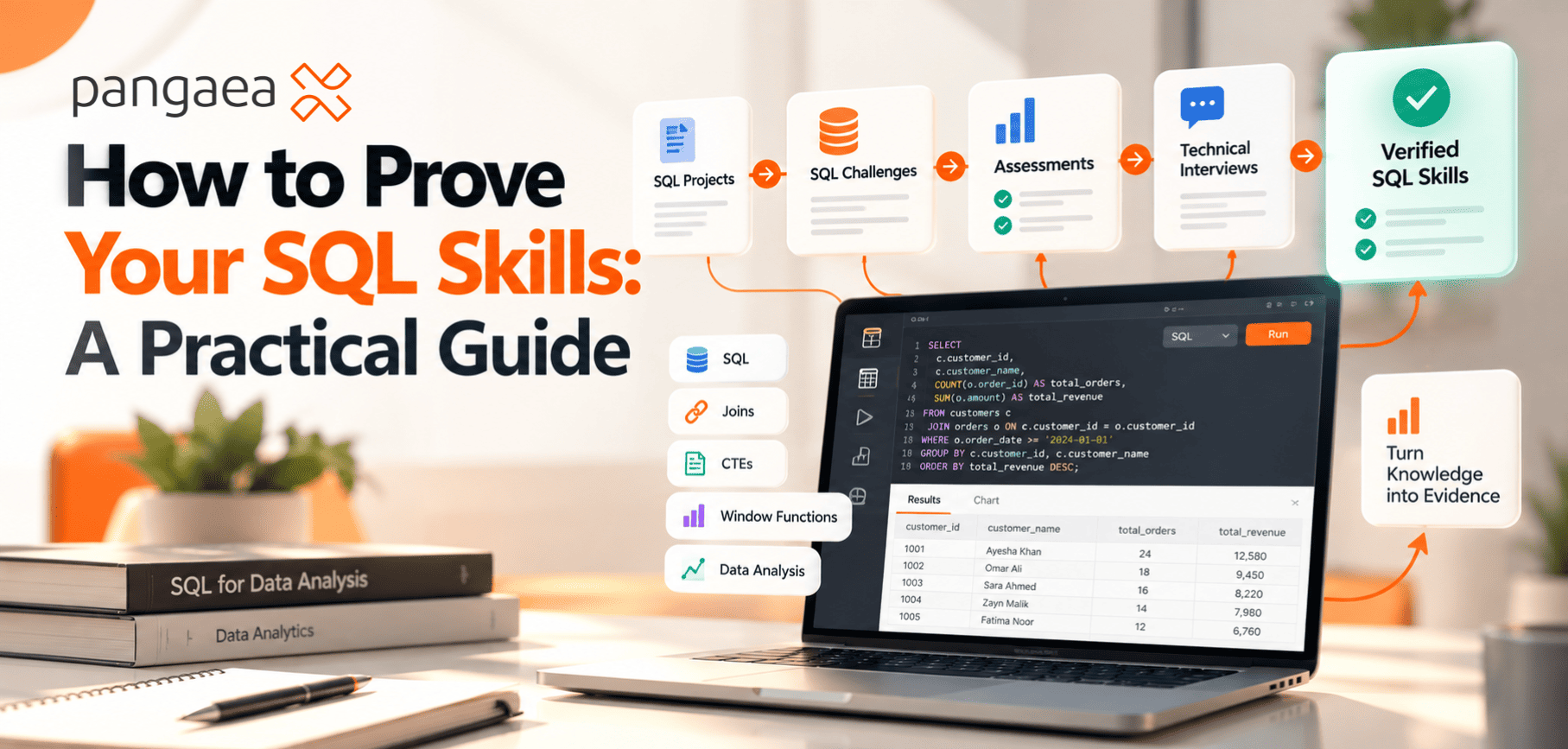
SQL Projects + Technical Challenges + Portfolio + Assessment + Technical Interview + Skill Verification
Each component provides different information.
Your project demonstrates application.
Your challenge results demonstrate problem-solving.
Your portfolio provides context.
Your assessment provides structured evidence.
Your interview demonstrates reasoning.
And skill verification can bring these signals together into a clearer professional profile.
Key Takeaways
- Listing SQL on your CV does not prove proficiency.
- Practical projects can demonstrate how you apply SQL.
- SQL challenges help demonstrate problem-solving ability.
- A strong portfolio should explain your reasoning, not just show queries.
- Joins, CTEs, window functions and analytical SQL are important areas to practise.
- Business problems provide a stronger test of SQL ability than syntax questions alone.
- Certifications can support your profile but are only one form of evidence.
- Technical assessments can provide structured evidence of SQL capability.
- Technical interviews can reveal how well you understand your SQL decisions.
- Skill verification can combine multiple forms of evidence to demonstrate professional capability.
Frequently Asked Questions
How can I prove my SQL skills?
You can prove your SQL skills through practical projects, SQL challenges, portfolios, technical assessments, interviews, certifications and structured skill verification.
What is the best way to demonstrate SQL proficiency?
The strongest approach is to combine practical SQL projects with technical challenges, assessments and the ability to explain your analytical reasoning.
Is a SQL certification enough to prove SQL skills?
Not always. A certification provides evidence of completing a defined programme or assessment, but practical projects and assessments can demonstrate how you actually apply SQL.
How can I show SQL skills on my CV?
Describe how you used SQL rather than simply listing it. Mention the problems you solved, SQL techniques you used and the outcomes of your work.
What SQL skills should a data analyst know?
A data analyst should generally understand querying, filtering, aggregation, joins, CASE statements, subqueries, CTEs, date functions and window functions, along with the ability to apply SQL to business problems.
Can SQL challenges improve my professional profile?
Yes. SQL challenges can demonstrate practical problem-solving and give you measurable evidence of your ability to work with SQL.
Can employers verify SQL skills?
Yes. Employers can use structured SQL assessments, technical challenges, portfolio reviews and technical interviews to evaluate SQL capability.
Can skill verification be used for SQL?
Yes. SQL is a suitable technical skill for structured verification because it can be evaluated through practical queries, analytical problems, assessments and technical interviews.