
SQL is one of the most important technical skills in data and analytics.
But how do you know whether someone can actually use SQL?
A CV may say “Advanced SQL.” A portfolio may contain several queries. A candidate may even have a SQL certification.
None of these alone tells you the full story.
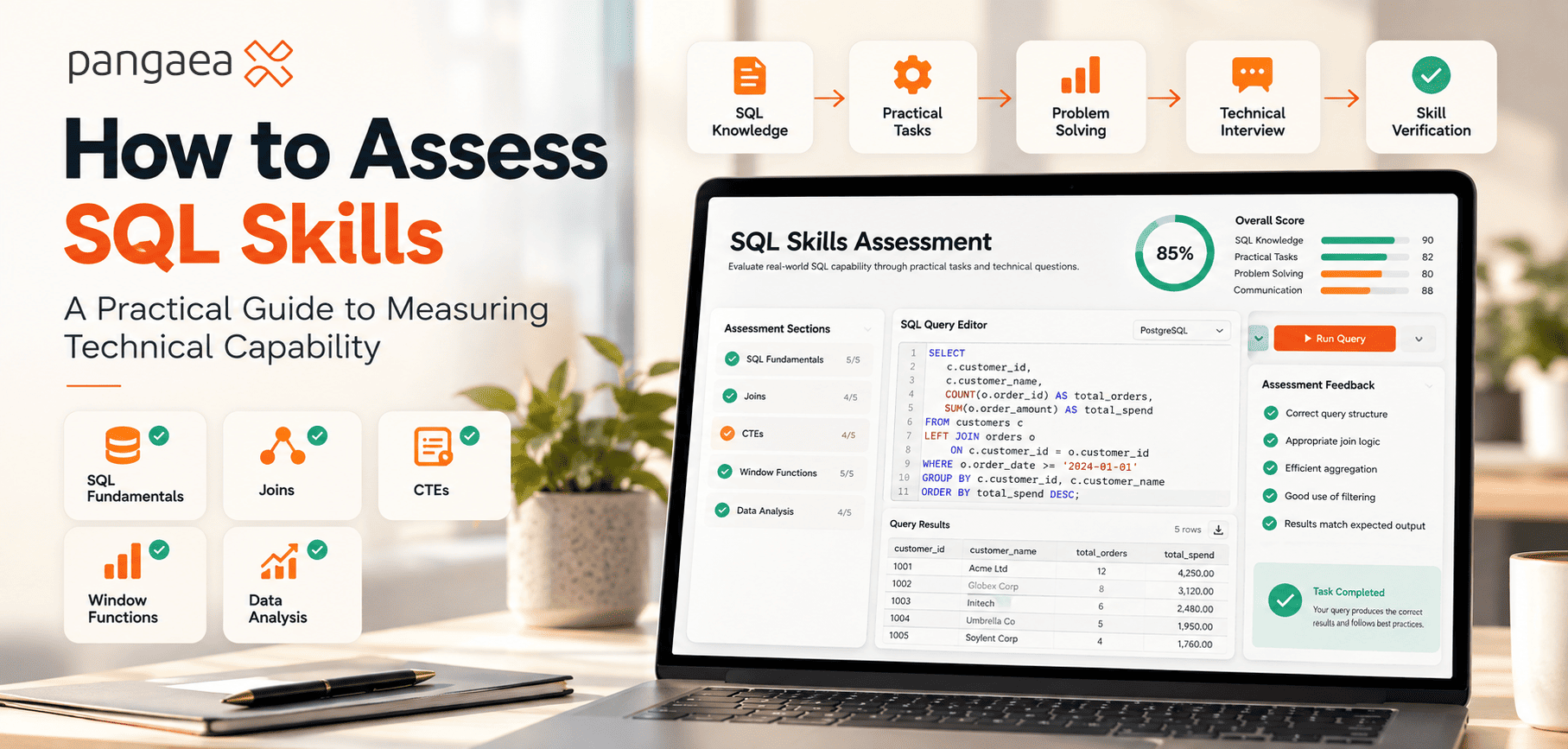
A better approach is to assess SQL through practical tasks, problem-solving, technical discussions and structured skill verification.
This guide explains how to assess SQL skills and what to look for at each stage.
What Does It Mean to Assess SQL Skills?
Assessing SQL skills means evaluating how well someone can use SQL to work with data and solve problems.
It is more than checking whether someone knows SQL commands.
A good assessment should answer questions such as:
- Can they retrieve data correctly?
- Can they combine multiple tables?
- Can they calculate useful metrics?
- Can they handle messy data?
- Can they solve unfamiliar problems?
- Can they use advanced SQL techniques?
- Can they explain their approach?
- Can they connect their analysis to a business question?
The goal is simple:
Measure demonstrated ability rather than relying only on claimed experience.
Why Is SQL Difficult to Assess from a CV?
A CV provides useful information.
However, it usually describes experience rather than demonstrating technical ability.
For example, someone might write:
SQL — Advanced
Another person might write:
Used SQL for customer analytics, reporting and data transformation.
Both statements sound positive.
However, neither tells you exactly what the person can do.
You still do not know whether they can:
- write complex joins
- use CTEs
- work with window functions
- optimise queries
- analyse large datasets
- solve unfamiliar problems
This is why practical assessment matters.
What SQL Skills Should You Assess?
A useful SQL assessment should cover several levels of ability.
SQL fundamentals
Start with the basics:
- SELECT
- WHERE
- ORDER BY
- GROUP BY
- DISTINCT
- aggregate functions
These skills show whether someone understands core SQL syntax.
Data relationships
Next, assess how well they work with multiple tables.
Test:
- INNER JOIN
- LEFT JOIN
- RIGHT JOIN
- FULL OUTER JOIN
- self joins
The important point is not simply whether someone remembers join syntax.
They should understand why a particular join is appropriate.
Analytical SQL
Then move into more advanced skills.
These can include:
- CTEs
- subqueries
- CASE statements
- window functions
- ranking
- rolling calculations
- date analysis
These techniques are common in real analytical work.
Problem solving
Finally, test whether the person can use SQL to solve a real problem.
This is often the most valuable part of the assessment.
What Should a Practical SQL Assessment Include?
A strong SQL assessment should resemble the type of work the person is expected to perform.
For example, imagine a company has customer, order and product tables.
Instead of asking:
What is a LEFT JOIN?
Give the person a practical problem:
Identify customers who placed an order in the last 90 days but have not purchased the same product twice.
Now they need to decide:
- Which tables are required?
- How should they be joined?
- Which filters are needed?
- How should duplicate purchases be identified?
- How should the result be presented?
This tests SQL knowledge and reasoning at the same time.
Should You Use SQL Multiple-Choice Questions?
Multiple-choice questions can be useful.
They are quick and easy to score.
They can test concepts such as:
- SQL syntax
- database concepts
- joins
- functions
- query behaviour
However, they should not be the only assessment method.
Someone can recognise the correct answer without being able to write the query themselves.
For this reason, combine knowledge questions with practical SQL tasks.
A better assessment can follow this structure:
Knowledge → Practical Task → Problem Solving → Explanation
This provides a much clearer picture of ability.
How Can You Assess SQL Through Real-World Problems?
Real-world scenarios are particularly useful because they test application.
For example:
Scenario
A subscription business has seen a decline in repeat purchases.
You provide the following tables:
- Customers
- Orders
- Products
- Payments
Then ask:
Identify the customer segments with the largest decline in repeat purchases.
The person may need to use:
- joins
- date functions
- aggregation
- CTEs
- window functions
- conditional logic
More importantly, they need to understand the problem.
This makes the assessment more meaningful than a list of isolated SQL questions.
What Are SQL Challenges and Why Are They Useful?
SQL challenges give people a specific problem to solve.
They are useful for both learning and evaluation.
For example:
Find the top three products by revenue in each category.
Or:
Identify customers who made purchases in three consecutive months.
These tasks reveal how someone approaches a problem.
They can also show whether a person can apply SQL concepts instead of simply remembering them.
PangaeaX's existing guide on How SQL Challenges Can Sharpen Your Data Analysis Skills explores this relationship between practical SQL challenges and analytical ability.
How Should You Assess Advanced SQL Skills?
Advanced SQL requires more than difficult syntax.
You should assess how someone handles complex analytical problems.
Useful areas include:
Common Table Expressions
Can the person break a complex problem into logical steps?
Window Functions
Can they rank, compare and calculate values across related rows?
Subqueries
Can they use nested logic when appropriate?
Date Analysis
Can they analyse trends across days, weeks, months and quarters?
Query Optimisation
Can they recognise inefficient queries and improve them?
Data Quality
Can they identify missing, duplicate or inconsistent data?
These areas provide a better picture of advanced SQL ability.
How Important Is Problem Solving in SQL Assessment?
Problem solving is extremely important.
A technically correct query is not always a good solution.
Consider this question:
Why did monthly revenue fall?
The person must first understand the question.
They may need to:
- Check the date range.
- Compare previous periods.
- Break revenue down by product.
- Compare customer segments.
- Look for unusual changes.
- Validate the results.
SQL is the tool.
Problem solving is the capability behind the tool.
That distinction matters when assessing technical talent.
Should You Assess SQL Communication Skills?
Yes.
Technical ability is only part of effective data work.
A person may write a correct SQL query but struggle to explain the result.
Ask them:
What does this query tell us?
Then ask:
What decision could someone make from this result?
This tests whether they can connect technical analysis to a wider objective.
For data analysts, this is particularly important.
They are often expected to communicate findings to people who do not work with SQL.
How Can You Assess SQL Skills During an Interview?
An interview can complement a practical assessment.
Instead of asking only theoretical questions, discuss a problem.
For example:
You have customer and transaction tables. How would you identify customers whose spending increased for three consecutive months?
Listen for the reasoning.
A strong answer should cover:
- required data
- joins
- date logic
- aggregation
- window functions
- validation
You can then ask:
What could make your results inaccurate?
This adds another layer to the assessment.
It tests whether the person can think critically about their own analysis.
How Can You Assess SQL Skills Without a Technical Expert?
This is a common challenge for smaller organisations.
A recruiter or manager may know that SQL is important.
However, they may not be able to evaluate complex SQL themselves.
In that situation, a structured assessment can help.
Instead of relying entirely on an internal technical expert, an organisation can use:
- standardised SQL challenges
- practical assessments
- structured technical interviews
- automated evaluation
- AI-assisted interviews
- skill verification
This can make the process more consistent.
It can also reduce the time technical employees spend screening every applicant.
How Can SQL Skill Assessment Help SMBs?
Smaller businesses often face a specific problem.
They need technical talent.
However, they may not have a large recruitment team or dedicated technical recruiters.
A structured SQL assessment can help them:
- screen candidates more consistently
- reduce manual technical screening
- compare candidates using the same criteria
- identify genuine technical ability
- reduce reliance on CV claims
- save technical team time
This does not mean removing human decision-making.
Instead, it gives the decision-maker better evidence.
What Is the Difference Between SQL Assessment and SQL Verification?
These terms are related, but they are not identical.
SQL assessment
An assessment measures performance against a defined set of tasks or criteria.
For example:
Complete five SQL problems.
SQL verification
Verification focuses on establishing evidence that a person genuinely possesses the claimed skill.
It can combine information from:
- professional experience
- portfolios
- assessments
- interviews
- practical demonstrations
The distinction is important.
An assessment asks:
How did you perform on this test?
Verification asks:
What evidence supports this person's SQL capability?
You can learn more about the broader concept in How Does Skill Verification Work? A Complete Guide.
Where Does AuthenX Fit Into SQL Skill Assessment?
This is where structured skill verification becomes particularly useful.
AuthenX by PangaeaX helps organisations evaluate and verify professional skills using candidate evidence, structured assessment and AI-led conversational interviews.
For SQL, the process can move beyond the CV.
A professional may claim:
“Advanced SQL.”
The organisation can then evaluate evidence and test relevant capabilities.
The process can include:
Candidate Evidence → SQL Assessment → AI Interview → Skill Evaluation → Verified Skill
This creates a more complete picture of capability.
It can also help organisations make more informed decisions about candidates, contractors, freelancers or existing team members.
How Can SQL Assessment Fit Into a Talent Process?
SQL assessment does not need to replace the existing recruitment process.
It can sit alongside it.
A practical workflow could look like this:
Step 1: Review the CV
Identify relevant experience.
Step 2: Assess practical SQL ability
Give the person realistic SQL tasks.
Step 3: Evaluate technical reasoning
Understand how they approach problems.
Step 4: Verify the claimed skill
Compare the evidence with the claimed level of proficiency.
Step 5: Make the decision
Use the combined evidence to decide whether the person is suitable for the opportunity.
This approach can work for:
- full-time recruitment
- freelance talent
- contractors
- internal mobility
- technical teams
- talent pools
What Makes a Good SQL Skills Assessment?
A strong assessment should be:
Relevant
Test skills that matter for the role or project.
Practical
Use realistic problems rather than only theoretical questions.
Consistent
Give comparable candidates a similar evaluation framework.
Measurable
Use clear scoring criteria.
Appropriate
Match the difficulty to the expected skill level.
Explainable
Make it possible to understand why someone received a particular result.
Efficient
Avoid creating unnecessary work for candidates or evaluators.
The objective is not to make the assessment difficult.
The objective is to make it useful.
What Should You Look for in SQL Assessment Results?
Do not focus only on whether the final query works.
Look at several signals.
| Area | What to evaluate |
|---|---|
| SQL knowledge | Understands core concepts |
| Query accuracy | Produces correct results |
| Problem solving | Understands the underlying problem |
| Data handling | Works correctly with real-world data |
| Advanced SQL | Uses CTEs and window functions appropriately |
| Efficiency | Avoids unnecessary complexity |
| Reasoning | Can explain the approach |
| Communication | Can explain the result clearly |
This creates a more balanced assessment.
How Can You Make SQL Assessment More Reliable?
Use multiple evidence points.
For example:
CV + Portfolio + Practical Assessment + Technical Interview + Skill Verification
Each source tells you something different.
A CV shows experience.
A portfolio shows previous work.
An assessment shows practical performance.
An interview shows reasoning.
Verification brings the evidence together.
This is much stronger than relying on a single data point.
How Can Professionals Benefit From SQL Skill Verification?
Skill verification is not only useful for organisations.
Professionals can also use it to demonstrate their capabilities.
Instead of saying:
“I know advanced SQL.”
they can provide stronger evidence of their ability.
This can help when pursuing:
- new roles
- freelance projects
- contract work
- internal opportunities
- technical assignments
For a broader look at demonstrating professional capability, see How to Prove Your Professional Skills?.
Key Takeaways
- A CV alone cannot fully demonstrate SQL ability.
- SQL assessment should test practical application.
- Real-world scenarios provide stronger evidence than simple theory questions.
- SQL challenges can test problem-solving ability.
- Advanced assessment should include CTEs, window functions, date analysis and complex queries.
- Technical interviews can reveal how someone thinks about SQL problems.
- Assessment can help organisations without large technical recruitment teams.
- SQL verification goes beyond a single test.
- Multiple evidence points provide a stronger view of technical capability.
- AuthenX can support a structured approach to skill assessment and verification.
- The same approach can be used for candidates, contractors, freelancers and existing teams.
Frequently Asked Questions
How can you assess SQL skills?
You can assess SQL skills through practical SQL tasks, technical challenges, real-world scenarios, interviews and structured skill verification.
What should a SQL skills assessment test?
A good assessment can test SQL fundamentals, joins, aggregation, CTEs, window functions, data cleaning, problem solving and the ability to explain results.
Are SQL challenges useful for assessing technical skills?
Yes. SQL challenges show how someone applies SQL to solve a specific problem.
Is a SQL certification enough to verify SQL skills?
Not necessarily. A certification can provide useful evidence, but practical assessments and demonstrations can provide additional evidence of capability.
How can SMBs assess SQL skills?
SMBs can use structured assessments, practical challenges and technical interviews. They can also use skill verification platforms to reduce the amount of manual technical screening required.
Can SQL skills be assessed without a technical recruiter?
Yes. A structured assessment can provide consistent evidence. Technical review or skill verification can then add further confidence.
What is the difference between SQL assessment and skill verification?
SQL assessment measures performance against defined tasks. Skill verification uses multiple forms of evidence to establish whether a person genuinely demonstrates the claimed capability.
Can AuthenX verify SQL skills?
AuthenX is designed to help evaluate and authenticate professional skills through candidate evidence, assessments and AI-led conversational interviews.