
Introduction
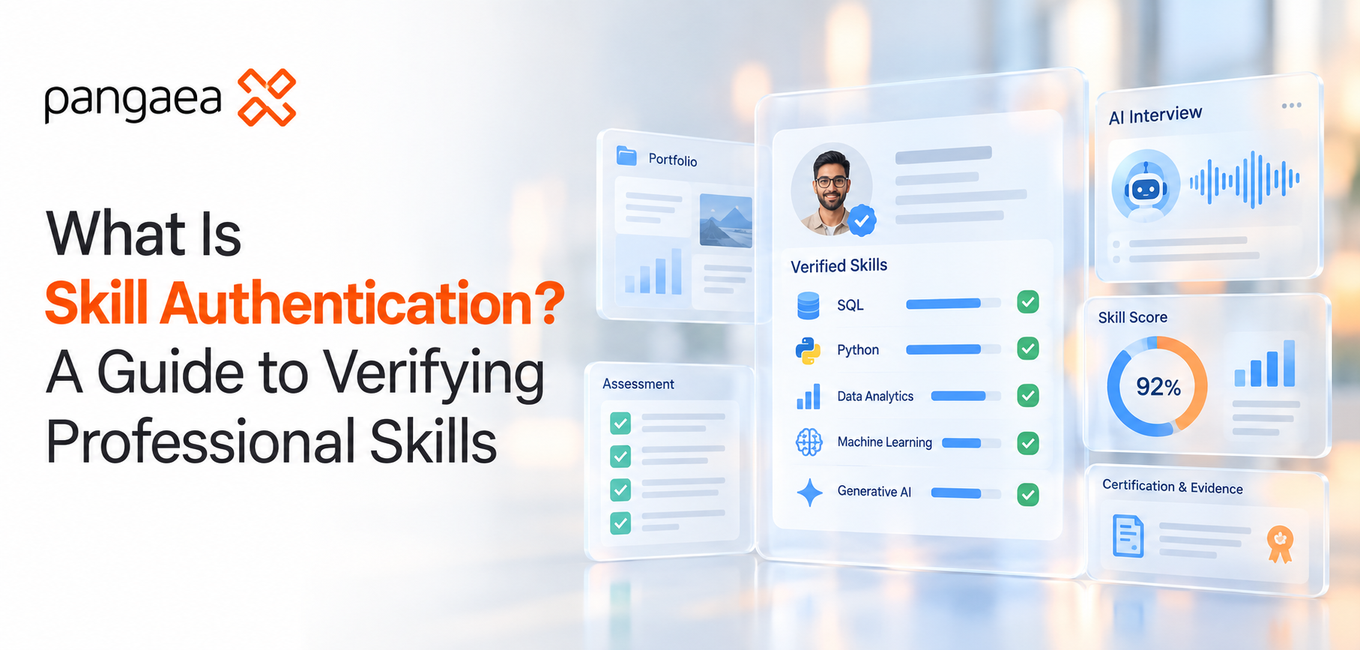
Skill authentication is the process of verifying that a person has the knowledge, technical ability, or practical capability they claim to have. It can involve structured assessments, practical challenges, portfolio evidence, interviews, or a combination of these methods.
A CV can tell an employer that someone has five years of Python experience. A LinkedIn profile can list SQL, machine learning and data analytics. A portfolio can show projects someone has completed.
But there is a difference between claiming a skill and demonstrating a skill.
Skill authentication helps bridge that gap by creating additional evidence of what a professional can actually do.
This is becoming particularly relevant in technical fields, where employers may need to evaluate skills such as SQL, Python, data analytics, machine learning, cloud computing and generative AI.
Why Is Skill Authentication Becoming Important?
The way people demonstrate professional capability is changing.
Traditionally, employers have relied heavily on:
- CVs
- qualifications
- years of experience
- references
- interviews
- professional certifications
These remain useful sources of information, but they do not always provide a complete picture of someone's practical capabilities.
Consider two professionals who both list SQL on their CV.
One may have used SQL occasionally for simple queries. The other may have several years of experience building complex analytical queries and working with large datasets.
The CV may not make that difference immediately obvious.
A structured skill assessment can provide additional evidence.
For professionals, this creates an opportunity to demonstrate their capabilities beyond a list of keywords.
For employers, it can provide another way to evaluate technical talent before making hiring decisions.
How Does Skill Authentication Work?
There is no single method that defines skill authentication. The approach depends on the skill being evaluated and the purpose of the verification.A professional skill authentication process can include several stages.
1. Review professional evidence
The process can begin with information such as:
- CVs
- portfolios
- project experience
- certifications
- professional profiles
- previous work
This establishes the individual's background and claimed experience.
2. Assess technical knowledge
A structured assessment can evaluate knowledge related to a particular skill.
For example, a SQL assessment might cover:
- SELECT statements
- joins
- filtering
- aggregation
- subqueries
- CTEs
- window functions
- analytical reasoning
A Python assessment might evaluate programming fundamentals, data manipulation, problem-solving or practical application.
3. Evaluate practical capability
Knowing the theory behind a technology is different from being able to apply it.
Practical assessments can therefore be used to evaluate how someone approaches realistic problems.
For example, a data analyst might be asked to analyse a dataset, identify trends, write SQL queries or explain an analytical approach.
4. Conduct a structured interview
An interview can provide additional evidence about how a professional thinks and communicates.
Technical interviews can explore:
- problem-solving
- technical decisions
- previous projects
- methodology
- trade-offs
- debugging
- real-world scenarios
5. Combine the evidence
Rather than relying on a single data point, skill authentication can combine multiple forms of evidence.
Professional profile + assessment + practical evidence + interview = a more complete skills picture.
What Is the Difference Between Skill Authentication and Certification?
Skill authentication and certification are related, but they serve different purposes.
Certification generally indicates that a person has met a defined standard or completed a particular examination, programme or credential.
Skill authentication focuses on providing evidence that an individual can demonstrate a particular capability.
For example:
| Certification | Skill Authentication |
|---|---|
| Represents a formal credential | Focuses on demonstrated capability |
| Usually follows defined requirements | Can combine different forms of evidence |
| Often associated with a course or examination | Can include practical assessment and interviews |
| May cover a broad subject area | Can focus on specific technical skills |
| Provides a recognised qualification | Provides evidence of capability |
They do not necessarily compete with each other.
A professional can hold a certification and use skill authentication to demonstrate how they apply that knowledge in practice.
What Skills Can Be Authenticated?
Skill authentication can be applied to many professional disciplines, but it is particularly relevant to technical skills.
SQL
SQL skills can be evaluated through querying, database concepts, analytical SQL and problem-solving.
Python
Python assessments can examine programming fundamentals, data manipulation, automation, analysis and practical problem-solving.
Data Analytics
Data analytics authentication can involve SQL, Python, statistics, data visualisation and analytical reasoning.
Machine Learning
Machine learning evaluation can cover modelling concepts, feature engineering, model evaluation and practical application.
Generative AI
Generative AI skills can include areas such as prompt engineering, large language models, retrieval-augmented generation, AI application development and model evaluation.
Data Engineering
Data engineering skills can involve databases, data pipelines, ETL/ELT, data warehousing and related technologies.
The important point is that the assessment should reflect the actual competency being evaluated.
How Can Professionals Verify Their Technical Skills?
Professionals can build evidence of their capabilities in several ways.
Build practical projects
Projects show that you have applied knowledge to a real problem.
Instead of simply listing Python on a CV, a professional can demonstrate how they used Python to analyse data, automate a process or build an application.
Create a professional portfolio
A portfolio provides context around previous work.
It can show:
- what you built
- why you built it
- which technologies you used
- the problems you solved
- the results you achieved
Complete structured assessments
A skills assessment can provide more standardized evidence of specific competencies.
Participate in technical challenges
Practical challenges can demonstrate problem-solving and technical application.
Complete a structured interview
Being able to explain your technical decisions can provide another layer of evidence.
Use skill authentication
A structured authentication process can bring several of these forms of evidence together into a clearer professional skills profile.
Is a Portfolio Enough to Prove Your Skills?
A portfolio can be valuable evidence, but it may not answer every question an employer has.
For example, a portfolio may show a completed data analytics project.
An employer may still want to understand:
- How much of the project did the individual complete?
- Can they explain their methodology?
- Can they solve a new problem?
- Do they understand the technical decisions they made?
- Can they apply the same skills in a different environment?
This is why different forms of evidence can complement each other.
A portfolio shows previous work.
An assessment evaluates specific capabilities.
A practical challenge tests application.
An interview explores reasoning and communication.
Together, these can provide a more complete picture than any single source.
How Does Skill Authentication Help Employers?
Skill authentication can be particularly useful when companies need to evaluate technical candidates.
A hiring team might receive dozens of CVs for a data analyst position.
Many candidates may list similar skills:
- SQL
- Python
- Excel
- Power BI
- statistics
- data analysis
The challenge is determining which candidates can actually demonstrate those skills.
A structured authentication or assessment process can help employers gather additional evidence before progressing candidates through the hiring process.
For example:
CV screening → skill assessment → technical interview → candidate evaluation
This approach can give hiring teams more information than CV screening alone.
It can also help create a more structured way of evaluating technical capabilities.
What Is the Role of AI in Skill Authentication?
Artificial intelligence can support parts of the skill authentication process.
AI-powered systems can help with activities such as:
- structured interviewing
- question generation
- candidate responses
- skills analysis
- assessment workflows
- interview summaries
- identifying relevant evidence
However, AI should support a structured evaluation process rather than simply replace human judgement.
The quality of the underlying assessment remains important.
If the goal is to verify SQL skills, for example, the evaluation should actually test meaningful SQL capability rather than simply ask whether someone has used SQL before.
How AuthenX Supports Skill Authentication
AuthenX by PangaeaX is designed around the idea of moving beyond simply listing skills to demonstrating them.
The platform combines elements such as portfolio and CV screening, AI-powered interviews and structured skill authentication to help create a clearer picture of professional capabilities.
For professionals, this provides a way to demonstrate technical skills through an authentication process rather than relying solely on self-reported experience.
For organisations, it can provide additional evidence when evaluating technical talent.
The underlying principle is simple:
Don't just list the skill. Demonstrate it.
What Is the Difference Between Skill Authentication and Skill Assessment?
Skill assessment generally refers to the process of evaluating someone's knowledge or ability in a particular area.
Skill authentication goes a step further by focusing on verification and evidence of the claimed skill.
For example, a person might complete a Python assessment and receive a result showing their performance.
Authentication can combine that assessment with other evidence, such as professional experience, portfolio information or an interview.
The terminology can vary between platforms and organisations, so the exact process should always be clearly defined.
Frequently Asked Questions About Skill Authentication
What is skill authentication?
Skill authentication is the process of verifying a person's professional or technical capabilities through assessments, practical evidence, interviews or other structured evaluation methods.
Why is skill authentication important?
It can provide additional evidence of capability beyond what is presented in a CV, portfolio or professional profile.
How do you authenticate technical skills?
Technical skills can be authenticated using structured assessments, practical challenges, portfolio evidence and technical interviews.
Can SQL skills be authenticated?
Yes. SQL authentication can evaluate areas such as querying, joins, aggregation, window functions, database concepts and analytical problem-solving.
Can Python skills be authenticated?
Yes. Python skills can be evaluated through programming assessments, practical challenges and structured technical interviews.
Is skill authentication the same as certification?
No. Certification generally represents a formal credential, while skill authentication focuses on evidence of demonstrated capability.
Can employers use skill authentication?
Yes. Employers can use structured skill verification and assessment as part of their technical hiring and candidate evaluation processes.
What is AuthenX?
AuthenX is a PangaeaX platform focused on authenticating professional skills through structured evaluation, portfolio screening and AI-powered interviews.
Key Takeaways
The fundamental goal is to move from claimed skills to demonstrated skills.s.
Skill authentication verifies whether a professional can demonstrate the skills they claim to have.
CVs and portfolios provide useful evidence, but they may not fully demonstrate practical capability.
Skill authentication can combine assessments, practical challenges, portfolios and interviews.
It is different from certification, although both can complement each other.
Technical skills such as SQL, Python, data analytics, machine learning and generative AI can be authenticated.
Employers can use skill authentication as an additional layer when evaluating technical candidates.
AI can support authentication through structured interviews, assessment workflows and analysis.