
Introduction
A technical test can show whether a candidate can write a query, select a model or answer a defined question. It does not always show whether the person understands the business problem, can explain a trade-off or has genuinely completed the projects described in a portfolio.
An AI-led assessment can explore those areas through follow-up questions and portfolio-based discussion. It also has limitations. Weak questions, opaque scoring or irrelevant signals can create a consistent-looking process without producing useful evidence.
The right question is therefore not whether AI assessments are universally better than technical tests. It is which format produces the evidence required for a particular decision.
What Counts as a Traditional Technical Test?
Traditional technical tests include multiple-choice questions, timed coding tasks, take-home assignments, case studies and tool-specific exercises.
They are useful when an employer or client needs to verify a defined capability, such as:
- Writing a SQL query
- Cleaning a dataset
- Debugging Python code
- Selecting an appropriate chart
- Calculating a business metric
- Explaining a machine-learning concept
- Building a small model or dashboard
The strongest tests resemble the actual work. A data analyst may be asked to investigate a metric change, while a BI developer may need to model data and implement an access rule.
A generic quiz may be easier to administer, but it provides less evidence about how the person will perform in context.
What Traditional Tests Reveal Well
Technical tests can provide direct evidence in several areas.
Defined technical knowledge
When the correct response is known, a test can efficiently verify whether the candidate understands a specific concept or tool.
Task execution
A coding or dashboard exercise can show whether the candidate can produce a working output.
Accuracy under consistent conditions
Every candidate can receive the same instructions, time limit and scoring rule.
Work sample quality
A relevant take-home task can reveal code structure, visual design, analysis and documentation.
These strengths make technical tests useful for narrow screening decisions or roles where a specific tool is essential.
What Traditional Tests Can Miss
The format also creates blind spots.
Reasoning behind the answer
A correct answer does not show whether the candidate understood the problem, guessed successfully or followed a memorised pattern.
Handling ambiguity
Real data work frequently involves unclear requirements, missing information and conflicting stakeholder expectations. Highly controlled tests can remove that context.
Project ownership
A portfolio may list an impressive model or dashboard, but a standalone test does not confirm which parts of that project the candidate personally completed.
Communication and judgment
Data professionals need to explain assumptions, limitations and business implications. These skills can be difficult to assess through a fixed-answer test.
Candidate access and circumstances
Strictly timed formats may disadvantage some candidates for reasons unrelated to job performance. Employers need to consider accessibility, accommodations and whether speed is actually relevant to the role.
What Is an AI-Led Skill Assessment?
An AI-led skill assessment uses an AI system to ask questions, interpret responses, generate follow-ups or apply a scoring framework.
The format may involve:
- A conversation about previous projects
- Questions generated from a resume or portfolio
- Scenario-based technical discussions
- Adaptive follow-up questions
- Structured evaluation of explanations
- A report describing assessed strengths and gaps
For data roles, the assessment can ask why a model was selected, how missing data was handled, which metric was used, what failed during implementation and how the result affected a business decision.
This can reveal depth that is difficult to capture with a generic question bank.
What AI-Led Assessments Can Reveal
Depth of understanding
Follow-up questions can test whether a candidate understands the choices described in an initial answer.
Analytical reasoning
The assessment can examine how the person moves from problem to evidence, method and recommendation.
Portfolio context
A discussion can explore the candidate's role, decisions, constraints and learning from a real project.
Communication
The candidate can demonstrate how clearly they explain technical work and adapt the explanation to a business context.
Consistency across a structured process
An AI system can apply the same assessment framework at scale. However, consistency is useful only when the questions and scoring criteria are valid for the role.
AI Skill Assessment vs Technical Test
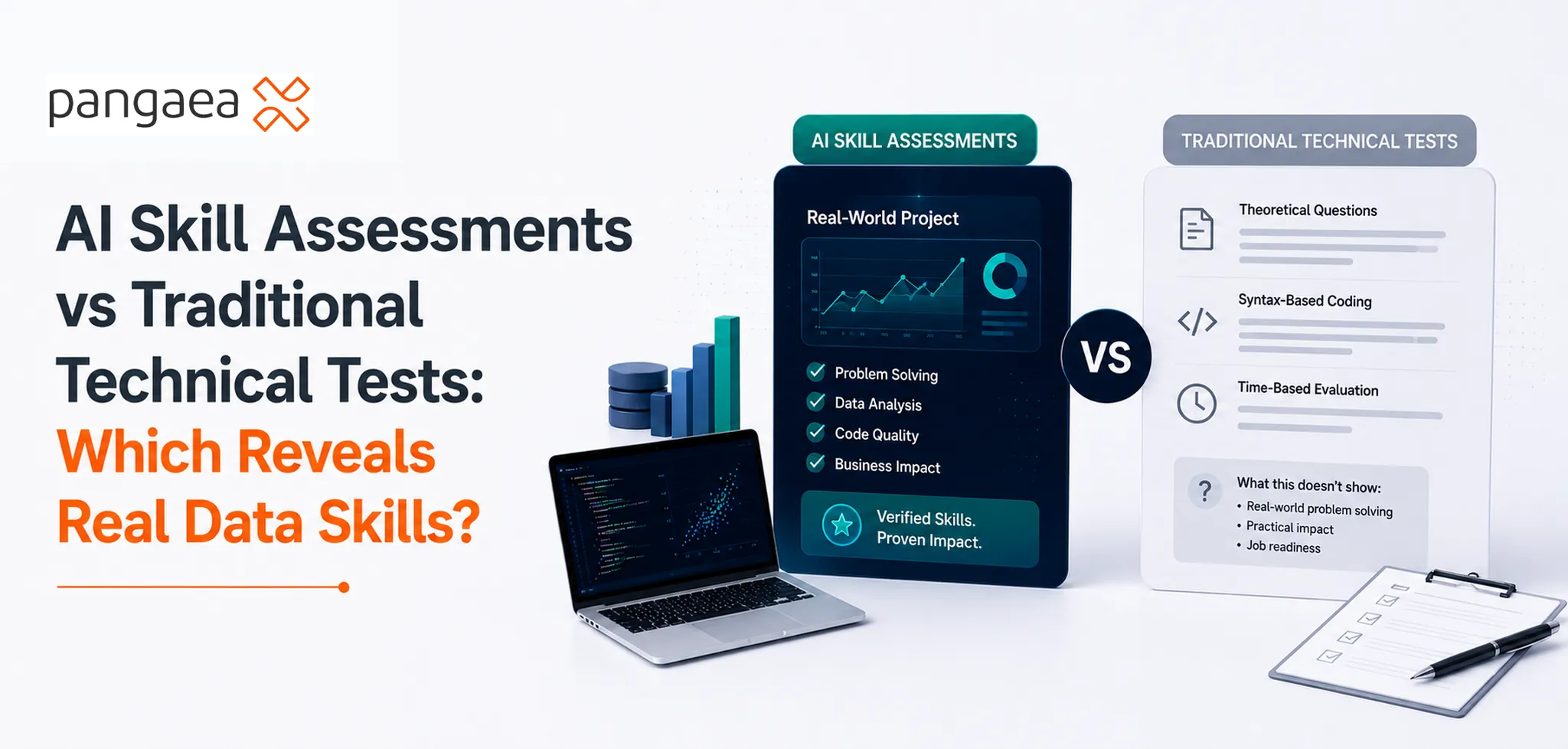
| Assessment dimension | Traditional technical test | AI-led assessment |
| Technical correctness | Strong for defined questions and tasks | Can assess correctness when reliable reference criteria exist |
| Reasoning | Limited unless explanation is required | Can explore reasoning through follow-up questions |
| Portfolio verification | Usually separate from the test | Can ask directly about project claims and decisions |
| Standardisation | Strong when instructions and scoring are fixed | Possible, but depends on prompt and scoring controls |
| Open-ended judgment | More difficult to score consistently | Better suited to structured conversation, with clear rubrics required |
| Candidate communication | Limited in coding or MCQ formats | Directly observable through responses |
| Transparency | Often clear for fixed-answer scoring | Can be unclear if evaluation criteria are not explained |
| Scalability | High for automated tests | High when the system is designed and monitored appropriately |
Neither column represents an automatic winner. The format should follow the competency being assessed.
Where AI Assessments Can Fail
Using AI does not remove the need for assessment design.
Questions may not match the job
An adaptive interview can still be irrelevant if it tests general knowledge instead of the role's actual work.
Scoring may be difficult to explain
Candidates and hiring teams need to know which competencies were evaluated and what the result represents.
Communication style can be confused with skill
Fluency, accent, response length or confidence should not become substitutes for job-relevant capability.
Portfolio claims may remain unverified
Asking about a project provides context, but it does not automatically prove ownership or accuracy. Supporting evidence may still be required.
Which Assessment Should You Use?
Use a traditional technical test when:
- A narrow skill must be verified
- The output has an objectively correct result
- The actual role includes similar tasks
- A practical work sample can be assessed reliably
- Speed is genuinely relevant to performance
Use an AI-led assessment when:
- Reasoning and explanation are important
- The candidate's portfolio requires deeper exploration
- The role involves ambiguous business scenarios
- Follow-up questions can reveal technical depth
- A structured conversation is more relevant than a fixed quiz
Use both when:
- The role requires technical execution and stakeholder communication
- A high-impact hiring or project decision requires several evidence types
- The technical task needs to be followed by a discussion of assumptions and trade-offs
A combined process might begin with portfolio screening, continue with a job-relevant work sample and conclude with a structured discussion. Each stage should answer a different question rather than repeat the same assessment.
Safeguards for Responsible AI Skill Assessment
Hiring teams and candidates should look for the following controls:
- Job relevance: Every assessed competency should connect with real role requirements.
- Defined scoring criteria: The system should explain what a strong response demonstrates.
- Consistent structure: Candidates should receive comparable opportunities to demonstrate the same competencies.
- Evidence traceability: Reports should connect conclusions with assessed areas rather than provide unexplained scores.
- Appropriate human review: Important or disputed decisions should not depend only on an automated output.
- Accessibility: The process should provide reasonable accommodations and avoid irrelevant barriers.
- Ongoing monitoring: Assessment outcomes should be reviewed for reliability, unexpected patterns and changing role requirements.
- Clear limitations: Users should understand what the assessment does not verify.
These safeguards are relevant whether the assessment is delivered by AI, a recruiter or a technical panel.
How AuthenX Approaches Skill Verification
AuthenX uses AI-led interviews and portfolio screening for data professionals. It is designed as a conversation-based alternative to generic tests.
The process begins with profile and portfolio information, followed by an AI-led interview that explores domain knowledge, problem-solving approach and project context. Participants receive a performance report and authenticated credential based on the platform's process.
This approach is most relevant when a professional wants to provide evidence beyond a self-declared list of tools. The interview can ask how a project was completed, why a method was chosen and what the professional learned from the result.
Readers who want to understand the workflow can review the AuthenX skill-verification process and the role of AI-led interviews in exploring data skills.
AuthenX should still be interpreted for what it is: one source of structured assessment evidence. Employers and clients should combine relevant evidence when the decision requires it.
Frequently Asked Questions
Are AI skill assessments more accurate than technical tests?
There is no universal answer. Accuracy depends on the competency, task design, scoring method, validation and decision being made.
Can an AI interview replace a coding test?
It may be more useful for reasoning, portfolio context and communication, but it does not automatically demonstrate coding execution. Use a work sample when direct coding evidence is required.
What should candidates ask before taking an AI assessment?
Ask what competencies are evaluated, how results are used, whether human review is available, what data is collected and whether accommodations can be requested.
Conclusion
Traditional technical tests are useful for verifying defined knowledge and task execution. AI-led assessments can add evidence about reasoning, project depth, communication and decision-making.
The strongest assessment is not the one using the newest technology. It is the one that matches the role, uses a clear structure, explains its limits and produces evidence that supports the actual decision.
For professionals who want conversation-based verification of their data skills, AuthenX provides an AI-led interview and portfolio-screening pathway within the PangaeaX ecosystem.