
Introduction
The data field has never had one job title. It has always been a collection of distinct roles that work with data in fundamentally different ways. But as the field has grown, the titles have multiplied, the tool stacks have expanded, and the lines between roles have blurred in ways that make it genuinely confusing to know which skills to build, which role to target, or which profile to hire for.
In 2026, job postings for data roles require more specific and varied skill sets than ever before. Understanding what each role actually demands, and where those demands overlap and diverge, is essential whether you are deciding what to learn next or evaluating candidates for a team.
Data Analyst
The data analyst role sits closest to the business. Analysts work with existing data to answer operational questions, track performance metrics, identify trends, and communicate findings to stakeholders who need to make decisions.
Core skills in demand:
- SQL - present in 52.9% of data analyst job postings. The foundational tool for querying, filtering, joining, and aggregating structured data
- Excel - still referenced in 50.5% of postings. Remains standard in business-facing reporting environments
- Power BI - 29% of postings. The leading BI tool for dashboard creation and business reporting
- Tableau - 26.2% of postings. Strong alternative to Power BI, particularly in organisations with existing Tableau environments
- Python - 31.2% of postings. Growing in the analyst role as automation and more complex analysis become expected
What makes analysts different from other roles:
The core output is interpretation and communication. Analysts translate data into language and visuals that non-technical stakeholders can act on. Domain knowledge matters significantly here. An analyst who understands the business deeply will always outperform one who only knows the tools.
Soft skills increasingly expected:
- Stakeholder communication: presenting findings clearly to non-technical audiences
- Business context fluency: connecting data patterns to operational decisions
Data Scientist
Data scientists sit at the intersection of statistics, programming, and machine learning. Where analysts describe what happened, data scientists go further to predict what will happen or to identify what should be optimised.
Core skills in demand:
- Python - 57% of job postings. The primary language for data science work across modelling, data manipulation, and automation
- Machine Learning - 69% of postings. The defining technical requirement that separates data scientists from analysts
- SQL - 30.4% of postings. Still essential for data access and manipulation upstream of modelling work
- R - 33% of postings. Particularly valued in research, statistics-heavy, and academic-adjacent environments
- NLP - 19% of postings, up from 5% in 2024. Reflects the rapid growth of language model applications across industries
Advanced tools increasingly expected:
- PyTorch and TensorFlow for deep learning work
- Cloud platforms for model deployment and large-scale computation
- Statistical validation and experiment design
What makes data scientists different:
The core output is a model or a system that generates predictions or decisions at scale. Data scientists need deeper mathematical grounding than analysts and are expected to understand not just how to apply an algorithm but why it behaves as it does on a given dataset.
Data Engineer
Data engineers are the infrastructure layer of data teams. They build, maintain, and optimise the pipelines, systems, and platforms that make clean, reliable data available for analysts and data scientists to work with.
Core skills in demand:
- SQL - 79.4% of postings. The highest SQL demand of any data role
- Python - 73.7% of postings. Used for building and automating data workflows and transformation logic
- Azure - 74.5% of postings. Cloud infrastructure is central to modern data engineering
- AWS - 49.5% of postings
- Apache Spark - 41.1% of postings. Essential for processing large-scale datasets efficiently
Additional tools commonly required:
- Apache Kafka for real-time data streaming
- Apache Airflow for pipeline orchestration
- ETL/ELT tooling for data transformation and integration
- NoSQL databases alongside relational SQL systems
What makes data engineers different:
The core output is reliable, scalable data infrastructure. Data engineers are not primarily concerned with deriving insights from data. They are concerned with ensuring that data flows correctly, arrives on time, and is accessible in the right form. Without strong data engineering, no analyst or scientist can do their job effectively.
Business Intelligence Analyst
BI analysts occupy a space between the data analyst and the data engineer, focused specifically on building the reporting systems, semantic layers, and dashboards that the business uses to monitor performance.
Core skills in demand:
- Power BI or Tableau - the primary delivery tools for BI work
- SQL - for querying data warehouses and building underlying data models
- DAX and LookML - tool-specific languages for defining metrics and business logic within BI platforms
- Data modelling - building star schemas, fact tables, and dimension tables that power efficient reporting
- Storytelling with data - translating complex data structures into dashboards that communicate clearly
What makes BI analysts different:
BI analysts own the system through which the business sees its own data. This requires both technical depth (building well-structured data models) and business understanding (knowing which metrics matter and how to present them clearly). The rise of AI features in BI tools like Power BI Copilot and Tableau Pulse is changing the workflow but not eliminating the need for well-structured underlying models.
Machine Learning Engineer
ML engineers bridge the gap between data science and software engineering. They take models built by data scientists and make them production-ready: scalable, reliable, monitored, and integrated into live systems.
Core skills in demand:
- Python - 56.3% of postings. The common thread with data science roles
- PyTorch - 39.8% of postings
- TensorFlow - 37.5% of postings
- SQL - 26.1% of postings. Lower than other roles but still present for data access and validation
- Java - 21.1% of postings. Relevant in enterprise environments with JVM-based infrastructure
- Cloud platforms - essential for deployment, scaling, and monitoring at production scale
What makes ML engineers different:
The core concern is operationalising models rather than building them from scratch. An ML engineer thinks about latency, reliability, retraining pipelines, monitoring for model drift, and integration with existing systems. MLOps practices and tooling are central to the role.
Where the Roles Overlap
Understanding the overlaps helps both professionals and hiring teams avoid confusion.
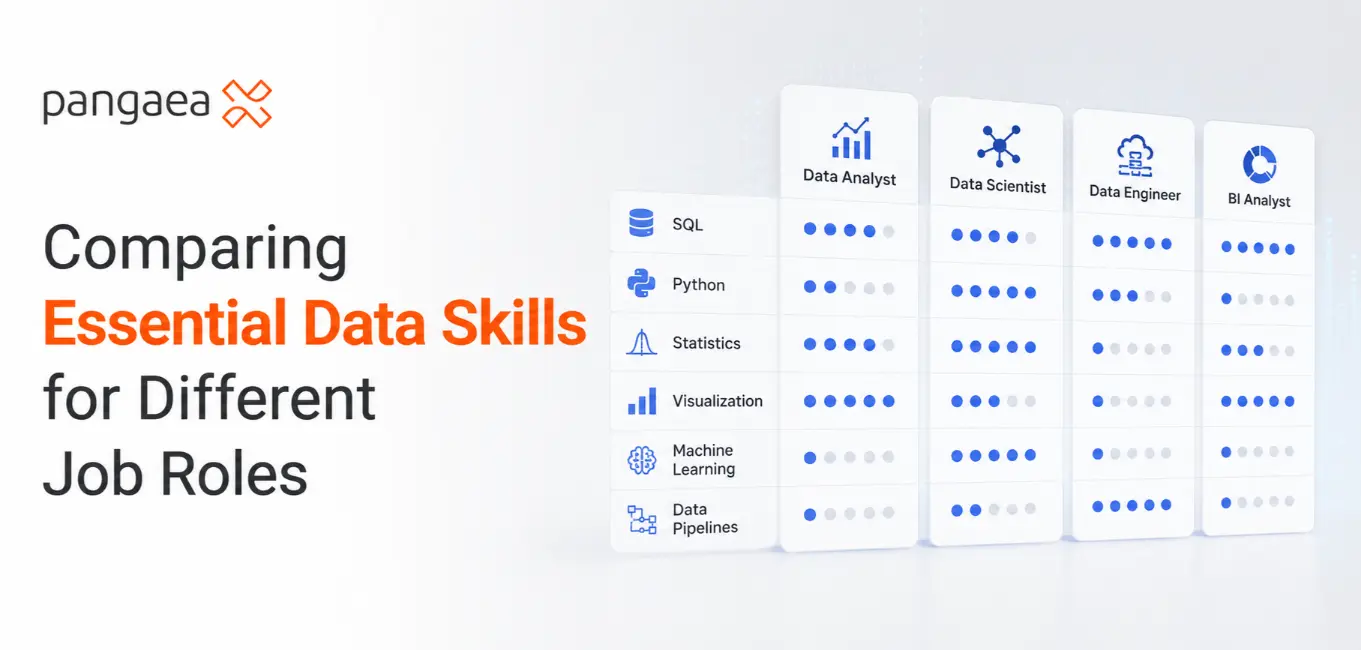
| Skill | Data Analyst | Data Scientist | Data Engineer | BI Analyst | ML Engineer |
| SQL | Core | Important | Core | Core | Supporting |
| Python | Growing | Core | Core | Optional | Core |
| ML/Modelling | Peripheral | Core | No | No | Core |
| BI Tools | Important | Peripheral | No | Core | No |
| Cloud Platforms | Basic | Growing | Core | Basic | Core |
| Communication | Core | Important | Supporting | Core | Supporting |
The clearest boundary is between data engineers (who build systems) and everyone else (who uses them). The blurriest boundary is between data analysts and BI analysts, which often depends on the organisation rather than the role itself.
Skills That Cross All Roles
Despite the differences, a small set of skills appears in demand across every data role in 2026:
- SQL - the lingua franca of the data field. No role is exempt.
- Python - either core or growing in every role listed above
- Communication - the ability to explain data work clearly remains universally valued
- Cloud awareness - even roles that don't deploy infrastructure are expected to understand cloud environments at a working level
What This Means in Practice
For data professionals, understanding where your current skills sit against this map tells you what to build next. Analysts moving toward data science need to deepen their Python and machine learning knowledge. Engineers moving toward broader data roles need to develop communication and business context skills. The clearest career paths always start with mastery of the core skills for your current role before expanding into adjacent ones.
For businesses hiring, the comparison above explains why a single "data person" job posting rarely attracts the right candidate. The skills for each role are genuinely distinct. A data engineer is not a data scientist with a different title. Getting specific about what the role actually requires produces better-fit candidates and faster hiring decisions.
On OutsourceX, freelance data professionals on PangaeaX are available across each of these specialisations, from data analysts and BI specialists to data engineers and ML engineers, matching project requirements with the right skill profile rather than a generic "data" label.
For data professionals who want to verify that their skills in any of these areas are credibly demonstrated rather than self-reported, AuthenX provides AI-powered skill authentication across the core competency areas that hiring managers are actively evaluating.